What is typical electric oven energy usage for pizzerias?
What is typical electric oven energy usage for pizzerias?
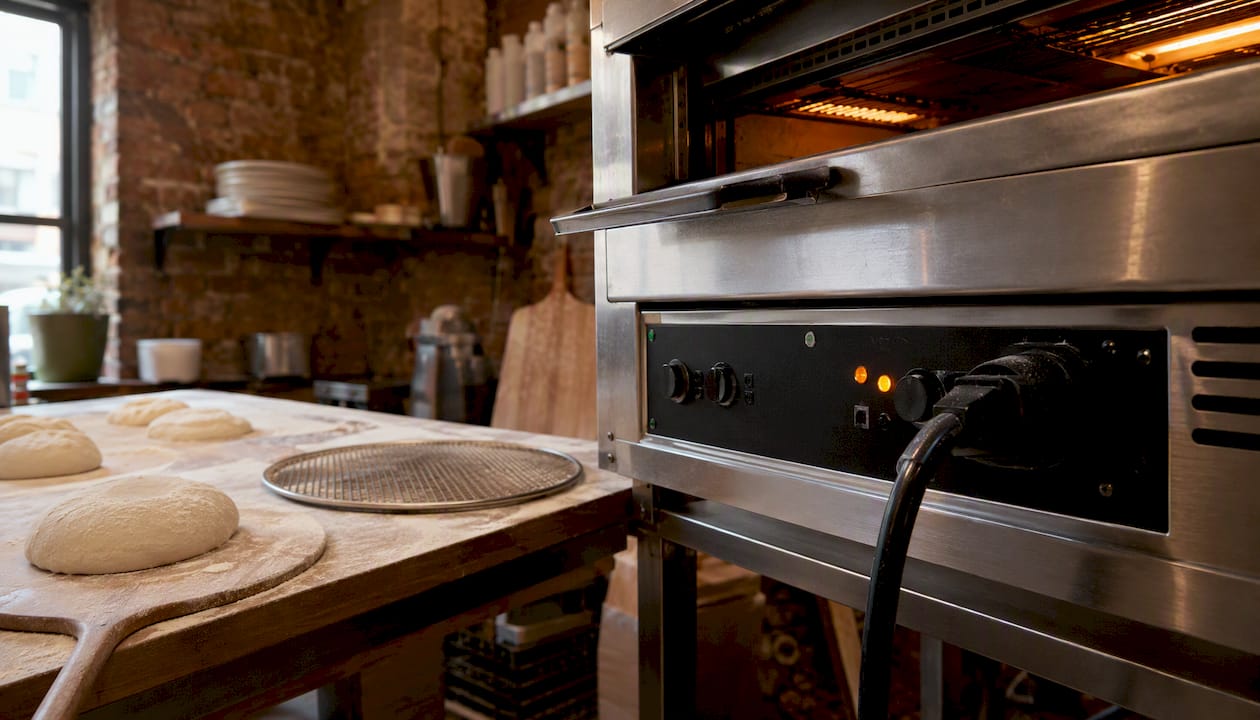
Most commercial electric pizza ovens draw between 3 kW and 34 kW, depending on chamber count and capacity. Multiply the kW rating by the hours it runs to get kWh, then multiply by your local electricity price to get cost per hour. A 12 kW double-chamber oven running flat out for an hour uses 12 kWh. At $0.20 per kWh, that’s $2.40 an hour. A single-chamber unit around 6 kW might cost half that. Before you do anything else, check the nameplate on the oven, or the spec sheet if you’re still shopping.
- Small single-chamber ovens: roughly 3–6 kW
- Double or triple-chamber deck ovens: roughly 12–17 kW
- Production, conveyor and large multi-deck units: roughly 12–34 kW, depending on capacity and chamber configuration
Statistic: at 12 kW and $0.20/kWh, an oven running eight hours a day costs roughly $19.20 daily, or around $134 a week, before you even account for preheat and idle draw.
Key Takeaways
Matching oven capacity to realistic throughput, not just chasing the lowest kW rating, is the single factor that most reliably controls your real electric oven operating cost.
| Point | Details |
|---|---|
| Check the nameplate first | Confirm the actual kW rating before estimating cost; ranges span roughly 3 kW to 34 kW across oven types. |
| Calculate cost per pizza, not just per hour | Divide kWh per hour by pizzas produced to see the real energy cost per pie, which often favours busier, larger ovens. |
| Budget for installation separately | Three-phase upgrades and hood requirements can outweigh the electricity cost itself over a year of service. |
| Request ECO and insulation specs | Ask suppliers for duty-cycle behaviour and standby modes, not just the maximum kW figure. |
| Vesuviano Forni builds for this calculation | Vesuviano Forni’s electric ovens pair patented dome insulation with ECO modes and full installation support to keep real-world energy use close to the numbers you calculate. |
Table of Contents
- How electric pizza ovens use energy: what the kW rating actually measures
- Key factors that drive operating cost in the real world
- Worked cost calculations for common oven sizes
- What electrical infrastructure does an electric pizza oven need?
- Which energy-saving features actually reduce electric oven consumption?
- When does an electric oven make sense for a hospitality business?
- Why the “cheapest oven” question misses the point
- Vesuviano Forni electric ovens: energy features and installation support
- Sources
How electric pizza ovens use energy: what the kW rating actually measures
The kW figure on a spec sheet is the oven’s maximum electrical draw, not what it consumes every minute of service. Understanding where that power actually goes helps you read a supplier’s numbers correctly and spot an oven that will cost more to run than its rating suggests.
Four things pull on that power budget:
- Heating elements doing the bulk of the work, bringing the dome and floor up to temperature and then holding them there against constant heat loss every time the door opens.
- Thermal mass and insulation determining how much energy leaks through the shell and door. A poorly insulated chamber cycles its elements far more often just to hold steady.
- Auxiliary loads from fans, motors, rotating decks and digital controls, which are small individually but add up on multi-deck or conveyor models.
- Preheat versus steady state, where the first hour of the day typically draws more than any hour after, because you’re heating cold refractory material rather than maintaining a hot one.
That last point catches out a lot of new operators. An oven quoted at 12 kW nominal might genuinely draw close to that figure during a 45 minute preheat, then settle to a lower average once it’s holding temperature between bakes.
Key factors that drive operating cost in the real world
A vendor’s kW rating tells you the ceiling, not the bill. What actually lands on your electricity invoice depends on how hard you run the oven and what your utility charges beyond the basic per-kWh rate.
- Duty cycle — a busy dinner-rush pizzeria might keep an oven near its rated draw for four or five hours solid, while a quieter operation cycles on and off and averages well below nameplate power across the same period.
- Throughput per pizza — divide kWh per hour by pizzas baked per hour to get your real energy cost per pie. A 12 kW oven producing 12 kWh in an hour that turns out 40 pizzas costs roughly 0.3 kWh per pizza; the same oven producing only 15 pizzas in that hour costs closer to 0.8 kWh each.
- Electricity pricing structure — flat per-kWh rates are the easy part. Demand charges and peak-hour pricing, common on commercial accounts, can push your effective rate well above the headline number if your oven’s draw coincides with your utility’s peak window.
- Installation add-ons — hood versus ventless configuration, panel capacity, and whether you need three-phase service all shift total cost of ownership even though they don’t show up on a monthly energy bill.
Pro Tip: Ask your utility provider for a breakdown of demand charges before you commit to an oven size. A 20 kW production model on a demand-charged tariff can cost more in fixed capacity fees than in the electricity it actually uses.
Worked cost calculations for common oven sizes
Numbers are easier to trust when you can run them yourself. Here are three scenarios using $0.20 per kWh, a mid-range figure for commercial rates in the United States, adjusted to whatever your utility actually charges.
A small single-deck oven rated around 4 kW, running at a 60% duty cycle across a four-hour dinner service, draws about 2.4 kWh per hour. That’s roughly $0.48 an hour. If it turns out 15 pizzas in that hour, you’re looking at about $0.03 in electricity per pizza, before ingredients or labour.
A medium double-deck oven rated at 14 kW, running closer to 80% duty cycle during peak hours, draws about 11.2 kWh per hour, or roughly $2.24 an hour. At 35 pizzas an hour, that’s around $0.06 per pizza.
A production or conveyor oven rated at 28 kW, running near-continuous during a busy shift, draws close to 25 kWh per hour once you account for steady-state efficiency, or about $5.00 an hour. At 70 pizzas an hour, the per-pizza energy cost drops to roughly $0.07, even though the hourly bill looks steep.
| Oven type | Nominal kW | Assumed duty cycle | kWh/hour | Cost/hour at $0.20/kWh |
|---|---|---|---|---|
| Single-deck | 4 kW | 60% | 2.4 kWh | $0.48 |
| Double-deck | 14 kW | 80% | 11.2 kWh | $2.24 |
| Production/conveyor | 28 kW | 90% | 25 kWh | $5.00 |
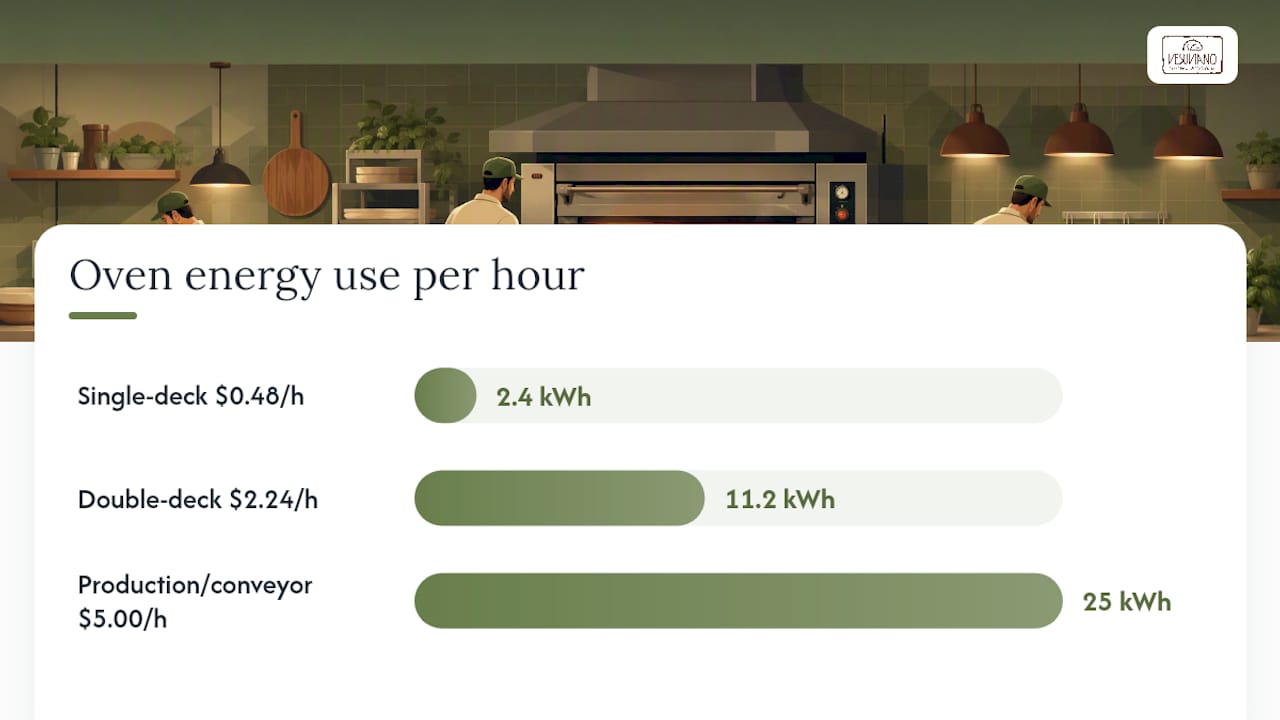
Swap in your own kW rating, duty cycle estimate and local electricity price, and the same table becomes a genuine budgeting tool rather than a generic example.
What electrical infrastructure does an electric pizza oven need?
The energy an oven consumes is only part of the cost story. What sits between the wall and the oven often determines whether the project is straightforward or expensive.
- Single-phase supply suits smaller countertop and single-deck ovens, typically under 6 kW, and rarely needs anything beyond a dedicated circuit.
- Three-phase supply becomes necessary for most double-deck, multi-deck and production ovens, which commonly require 60 to 80 amp service or higher.
- Panel upgrades are the hidden cost that catches operators out. If your existing panel can’t support the additional amperage, budget for an electrician’s assessment before you order the oven, not after.
- Ventless electric configurations can sidestep hood and ductwork spend entirely, which shifts real capital away from construction and towards the oven itself. Check with your local fire code and equipment supplier whether your specific model and kitchen layout qualify.
None of this changes your per-kWh cost, but it changes what the oven actually costs you to install, and that number often dwarfs a year of electricity bills.
Which energy-saving features actually reduce electric oven consumption?
Some features genuinely cut consumption; others are marketing gloss on a spec sheet. Knowing which is which saves you from paying extra for the wrong thing.
Look for these when comparing quotes:
- ECO or standby modes that reduce element duty during quiet periods rather than holding full temperature around the clock.
- Improved insulation and refractory design, which lowers the ongoing energy needed to maintain dome and floor temperature between bakes.
- Rapid-heat or boost functions that shorten preheat time, cutting the most energy-intensive part of the day.
- Zoned heating controls, letting you run only the chambers you need during slower shifts rather than heating an entire multi-deck unit for a handful of orders.
On the operational side, batch scheduling matters more than most managers assume. Grouping bakes rather than firing the oven up and down all day keeps it in its efficient steady state. Avoid leaving an oven at full temperature through long dead periods, and train staff to recognise which chambers actually need to be hot for the next ticket.
Pro Tip: If your utility offers time-of-use pricing, shift preheat to the cheapest rate window where your service schedule allows. Preheat is the single largest energy draw of the day, so timing it well can meaningfully soften your bill.
When does an electric oven make sense for a hospitality business?
Electric ovens suit operations that value consistency and clean operation over raw flame temperature. They hold a set temperature reliably, need no combustion venting in many configurations, and are straightforward to clean, which matters in shared or enclosed kitchens where gas or wood-fired flues aren’t practical.
The trade-off is cost per kWh, which in many markets runs higher than the equivalent gas or wood energy cost, and a lower typical maximum temperature than a wood-fired Neapolitan setup can reach.
- Electric tends to win in food halls, hotels, shared kitchens and mobile operations, where ventilation, space or lease restrictions make combustion appliances impractical.
- Wood-fired or gas may still make sense where maximum dome temperature and traditional flavour are the priority, and where the venue already has the infrastructure to support them.
Most operators end up choosing based on kitchen constraints and menu identity first, energy cost second.
Why the “cheapest oven” question misses the point
The most common mistake we hear at Vesuviano Forni isn’t buying the wrong oven. It’s asking the wrong question. Operators fixate on the kW rating as though it’s a fixed monthly bill, when duty cycle and throughput usually matter more than the number on the spec sheet.
An oven rated lower on paper can cost more per pizza if it’s undersized for your volume and runs closer to continuous duty than intended. A larger oven, properly matched to throughput, often works out cheaper per pie despite the bigger nameplate figure.
The conventional advice, buy the smallest kW rating that fits your budget, gets this backwards. What you should prioritise first is matching oven capacity to realistic peak-hour throughput, then let the energy calculation follow from that. Get the sizing right, and the energy cost tends to look after itself.
Vesuviano Forni electric ovens: energy features and installation support
Vesuviano Forni is the alternative to guessing your way through a spec sheet: our electric ovens are built by artisans with over 50 years of Neapolitan oven-making experience, engineered with modern insulation and ECO modes so the numbers you calculate above actually hold up in service.
Our electric Neapolitan pizza ovens combine a patented brick dome with refined insulation, keeping heat loss down and reducing the duty cycle needed to maintain steady temperature. That means the “assumed duty cycle” column in your own calculation table starts from a stronger baseline than a poorly insulated competitor unit. For operators considering a rotating or higher-throughput setup, our rotating pizza oven range is built with the same attention to thermal efficiency.
Beyond the oven itself, our team manages the full project: technical consultancy, international logistics, customs clearance and on-site installation, including support for electrical and ventilation planning specific to your site. If you want numbers built around your own kitchen rather than a generic example, get in touch through our electric oven product page and request a tailored energy and installation estimate. Our team is at your disposal.
Sources
- Unlocking the secrets of Neapolitan pizza: A concise review of wood‐fired, electric, and gas pizza ovens (Falciano et al., 2024)
- Gas ovens vs electric ovens: heating up (PizzaToday, 2024-01-29)
- Commercial tunnel pizza oven cost: price & install (PizzaOvenWorld)