Buying a handcrafted Neapolitan oven: the grease duct pizza oven guide
Buying a handcrafted Neapolitan oven: the grease duct pizza oven guide
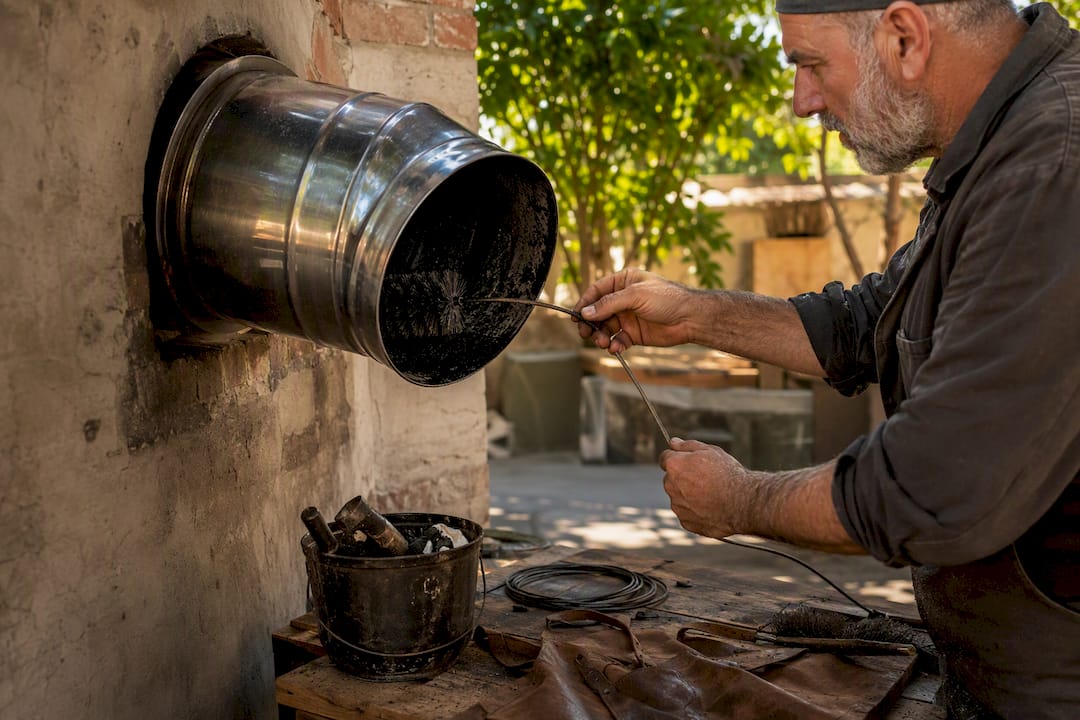
The best route for a restaurant buying a handcrafted Neapolitan oven is simple: select a factory-backed artisan oven that comes with US-relevant certifications and a proper export and installation package, then get the manufacturer on a call before you sign anything else. This matters because it protects two things at once: the cooking performance you’re actually paying for, and your ability to get past your local Authority Having Jurisdiction (AHJ) without a redesign halfway through the project. A handcrafted oven built without regard for US inspection expectations can sit in a warehouse for months while paperwork gets sorted out.
Take these two steps now:
- Pull together your menu mix, expected covers per service, and target bake times, so any manufacturer you speak to can size and specify the right oven for your kitchen.
- Contact the manufacturer for a site-specific technical consultation, and raise your local AHJ’s ventilation stance in that first conversation, not the last one.
Key Takeaways
Choosing a grease duct pizza oven successfully depends on aligning oven type, US certification documentation, and AHJ engagement before manufacturing begins, not after.
| Point | Details |
|---|---|
| Lead with certification | Request UL 2162 test documentation and field label eligibility before finalising your oven order. |
| Match oven type to operations | Choose wood, gas, electric, or rotating based on throughput, ventilation, and staffing realities, not aesthetics alone. |
| Engage your AHJ early | Some masonry ovens avoid a blanket Type I hood requirement when tested and field-labelled correctly. |
| Budget beyond the oven | Freight, duties, installation labour, and ongoing duct cleaning all belong in your project total. |
| Choose a full-service supplier | Vesuviano Forni pairs handcrafted RealBosco, Sebastian, and VesuvioBuono ovens with export logistics, installation, and technical consultancy for US buyers. |
Table of Contents
- What to prioritise when buying a grease duct pizza oven
- Oven types explained: wood, gas, electric and rotating
- What US certifications matter for a grease duct pizza oven?
- How long does it take to install an imported Neapolitan oven?
- How Vesuviano Forni supports US buyers
- Regular cleaning and maintenance protocols for grease ducts specific to pizza ovens
- Common causes and prevention of grease fires in pizza oven grease ducts
- What should an ongoing grease duct inspection checklist include?
- Retrofitting existing kitchens for a grease duct pizza oven
- Cost breakdown of grease duct installation and maintenance for pizza ovens
- The gap between what buyers plan for and what actually happens
- Ready to plan your oven project with Vesuviano Forni
- Frequently asked questions
- Sources
What to prioritise when buying a grease duct pizza oven
Every oven decision should start with your menu, not the brochure. A pizzeria running a high volume of covers on a Friday night needs different thermal recovery than a hotel restaurant serving a smaller number of pies for a tasting menu. Bake time, dome shape, and floor mass all follow from that number, not the other way round.
- Match the oven to your service model. Peak-hour volume, pie style (Neapolitan versus New York, versus a hybrid menu), and target bake time (60 to 90 seconds for a true Neapolitan pie) determine dome diameter and mouth width before anything else does.
- Scrutinise the build, not just the finish. Ask what refractory material lines the dome, how the floor is composed, and how the dome geometry is engineered for heat retention. A handcrafted masonry dome with strong thermal mass recovers floor temperature between pies far faster than a lightweight alternative, which is the difference between consistent bakes and a slow, uneven service.
- Plan your staffing and fuel logistics. Wood-fired ovens need a pizzaiolo who can read the flame, plus a dependable, code-compliant wood storage area. Factor this into labour costs before you commit to a fuel type.
- Measure your site before you order. Footprint, mouth width, ceiling height, and delivery access (can a crated dome or a crane-lifted unit actually reach your kitchen?) all shape which build method and finish are realistic.
Pro Tip: Photograph your loading dock, doorways, and kitchen entry points and send them to your oven supplier before final design. It’s far cheaper to solve an access problem on paper than on delivery day.
Oven types explained: wood, gas, electric and rotating
Oven type is a business decision dressed up as a technical one. Each family solves a different operational problem, and the right choice depends on what your dining room, ventilation setup, and kitchen crew can actually support.
- Wood-fired ovens deliver the flame, smoke aroma, and open-hearth theatre that define an authentic Neapolitan experience, but they demand a serious ventilation strategy and a skilled operator to manage fuel and heat by feel.
- Gas-assisted and combined gas/wood ovens hold high dome temperatures with far less manual fuel management, simplifying fuel storage and giving kitchens a steadier, more predictable recovery time between pies.
- Electric ovens suit venues where indoor combustion isn’t practical, whether due to landlord restrictions, building type, or a local jurisdiction that limits open-flame appliances. You lose the wood aroma but gain precise digital temperature control and a far simpler path through some AHJ reviews.
- Rotating and multi-deck ovens are built for throughput. A rotating deck keeps bake times consistent across a high-volume service without a pizzaiolo constantly turning pies by hand, which matters when you’re pushing several hundred covers a night.
None of these is objectively “best.” A neighbourhood pizzeria chasing an open-flame, wood-fired identity has different needs than a food hall stall running electric decks back to back all day. The honest exercise is mapping your throughput target and your building’s ventilation reality against each oven type, then choosing the one that survives contact with both.
What US certifications matter for a grease duct pizza oven?
Three standards come up repeatedly once your oven order reaches your local inspector’s desk, and knowing them before that conversation happens saves weeks.
- UL 2162 is the primary US standard covering commercial wood-fired refractory baking ovens, and it’s the document most inspectors will ask about first. An oven tested to UL 2162 has a documented path to a field label, which is often the single fastest way through an AHJ review.
- ANSI/NSF-4 addresses commercial food equipment sanitation, and UL 737 covers safety for gas ranges and ovens. Both are worth confirming with your manufacturer alongside UL 2162, particularly on gas-assisted models.
- Ask your supplier for documentation you can hand directly to your AHJ: test reports, field label eligibility, and installation instructions written for a US inspector, not a European one.
Here’s the detail that catches buyers out: some masonry ovens tested under UL 2162 have been installed without a blanket Type I hood requirement, because the AHJ accepted a field evaluation and the manufacturer’s own installation instructions instead. That outcome is never guaranteed. AHJs vary enormously; one jurisdiction will insist on a full Type I hood for any open-flame appliance, while another accepts a tested oven with a field label and manufacturer documentation. That gap can move your total project cost by tens of thousands of dollars, which is exactly why the ventilation conversation belongs at the start of your project, not after the oven has shipped.
How long does it take to install an imported Neapolitan oven?
A handcrafted oven built in Naples doesn’t arrive next week, and pretending otherwise is how projects blow their opening dates. Custom finishes, bespoke mosaic work, or a decision to have the oven built directly on your premises will all extend the base timeline further, so build in a buffer rather than working backward from a fixed opening night.
- Confirm lead time at order stage. Standard builds ship faster than fully bespoke designs; ask your manufacturer for a realistic production window before you commit to a launch date.
- Let the manufacturer handle export. A supplier experienced in international logistics, customs clearance, and freight documentation removes most of the friction that trips up first-time importers.
- Prepare your site in parallel. Foundation work, gas or electrical utilities, and clear delivery access all need to be ready before the oven lands, not started once it arrives at the port.
- Budget beyond the oven price. Freight, import duties, on-site installation labour, and any crane or hoist hire for heavy masonry components are separate line items that belong in your project budget from day one.
Vendors with genuine export experience materially cut project risk here, because they’ve already solved the customs and logistics problems your project will hit for the first time.
How Vesuviano Forni supports US buyers
Vesuviano Forni brings together Neapolitan artisans with generations of oven-building experience, organised into three product families built for different business needs.
- RealBosco ovens carry the classic handcrafted mosaic look, available in wood-fired, gas, electric, and rotating versions, for operators who want the most traditional Neapolitan aesthetic without compromising on cooking performance.
- Sebastian ovens pair the same handcrafted construction with a contemporary metal-slat finish, suited to venues with a more modern dining room design.
- VesuvioBuono ovens use a low-emission system that eliminates black soot, a genuinely practical choice where local ventilation rules or environmental concerns make a traditional wood-fired setup harder to approve.
Beyond manufacturing, Vesuviano Forni runs an end-to-end service covering technical consultancy, custom design, international logistics, on-site assembly, and after-sales support, managed from first sketch to final installation.
Regular cleaning and maintenance protocols for grease ducts specific to pizza ovens
A grease duct serving a pizza oven line accumulates residue differently than one serving a fryer bank, because wood-fired and gas ovens produce a mix of smoke particulate and grease vapour from cheese and toppings that condenses along duct walls over time. That build-up is exactly what fire codes are written to prevent.
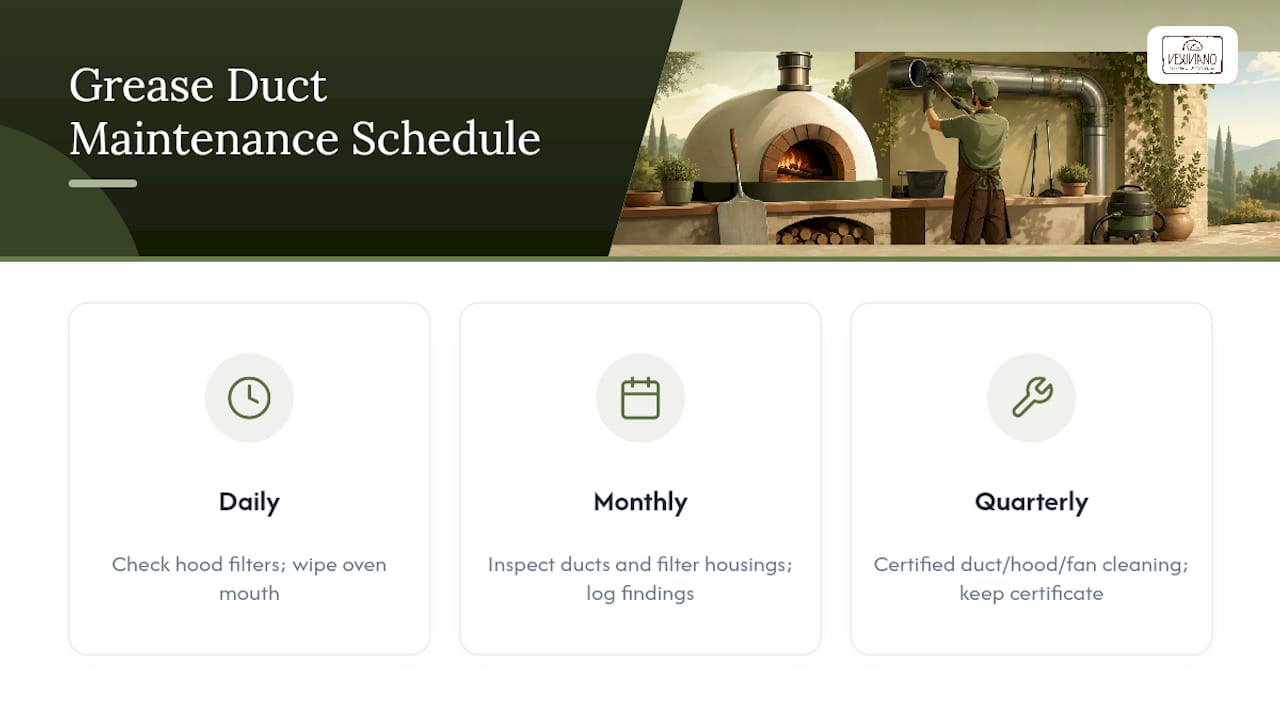
A workable maintenance schedule has three tiers. Daily, staff should visually check hood filters and wipe down accessible surfaces around the oven mouth, since grease that never reaches the duct is grease you never have to clean out of it later. Monthly, someone on your team should inspect accessible duct sections and filter housings for visible buildup, logging what they find so patterns show up over time. Quarterly to semi-annually, depending on your volume and local code, a certified grease duct cleaning contractor should perform a full cleaning of the duct interior, hood, and exhaust fan, and issue documentation you can produce for an inspector on request.
Cleaning frequency should scale with your cooking volume, not a calendar default. A pizzeria running two ovens through 500 covers a week generates more residue than a low-volume café oven and needs more frequent attention. Keep every cleaning certificate on file; it’s the first document most fire marshals ask for during a routine inspection, and its absence is one of the most common reasons a kitchen fails a check that should have been routine.
Common causes and prevention of grease fires in pizza oven grease ducts
Grease duct fires rarely start from a single dramatic event. They build from accumulated residue that ignites when duct temperatures rise unexpectedly, which happens more often near a pizza oven than most operators assume, given the high, sustained heat these ovens produce compared with standard cooking equipment.
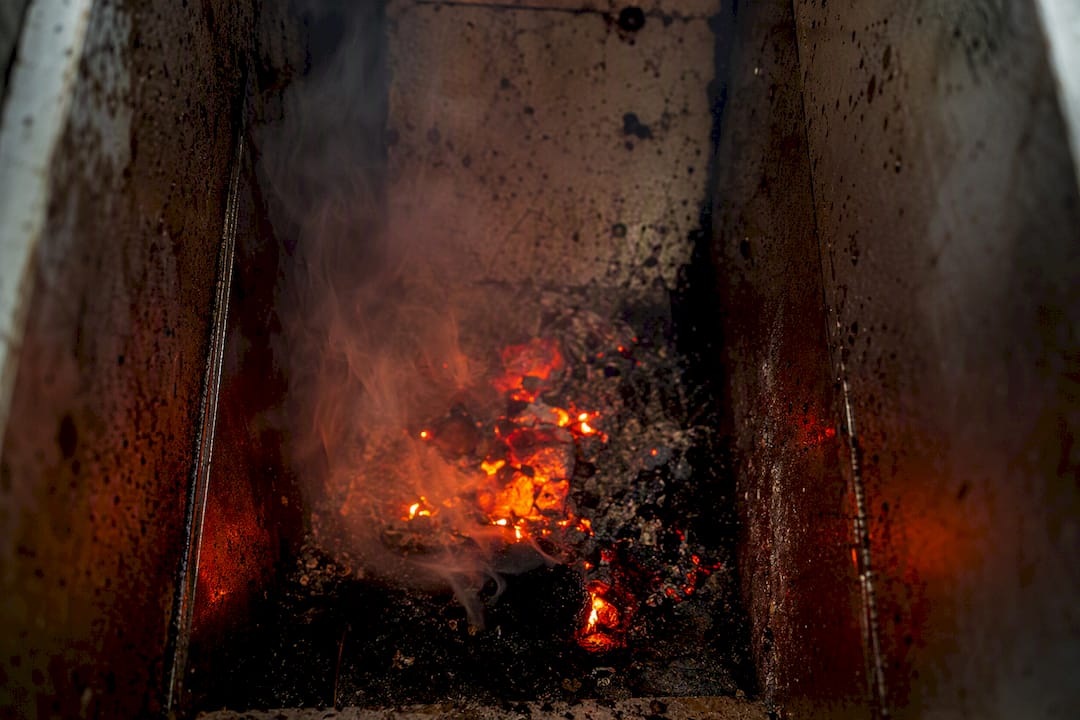
The most common cause is straightforward neglect: cleaning intervals stretched too far apart, or a duct section that’s hard to access getting skipped during routine maintenance. A close second is heat exposure beyond what the duct system was designed for, particularly in wood-fired setups running longer or hotter than the ventilation design anticipated. Damaged or missing fire dampers, and filters that were never replaced or cleaned properly, round out the usual list.
Prevention starts with matching your ventilation design to your actual oven output before installation, not after a near miss. That’s precisely why AHJ conversations and manufacturer documentation matter so much earlier in this guide: an oven and duct system specified together, with accurate heat and airflow figures, is inherently safer than one bolted onto an existing setup and hoped for the best.
Beyond design, the controllable factors are consistent cleaning intervals, functioning fire suppression systems tied into the hood, and staff trained to recognise early warning signs such as unusual heat radiating from duct sections or a persistent burnt-grease smell that doesn’t clear after cleaning.
What should an ongoing grease duct inspection checklist include?
Compliance isn’t a one-time event you clear during your opening inspection and forget. It’s a running commitment, and the operators who treat it that way rarely get caught out by a surprise fire marshal visit.
A practical checklist covers four areas on a recurring basis:
- Duct interior condition: visible grease accumulation, corrosion, or damage to duct seams and joints.
- Fire suppression system: verify the system is charged, unobstructed, and within its scheduled inspection date.
- Fire dampers and access panels: confirm dampers move freely and access panels are intact and properly sealed.
- Documentation: cleaning certificates, suppression system service records, and any AHJ correspondence, all filed together and easy to produce on request.
Keep a physical or digital log that a manager reviews monthly, not just whenever a cleaning contractor visits. Most jurisdictions expect cleaning frequency documentation, and a paper trail that shows consistent attention over time carries far more weight during an inspection than a single recent certificate.
Retrofitting existing kitchens for a grease duct pizza oven
Plenty of restaurant owners aren’t building a kitchen from scratch. They’re adding a Neapolitan oven to a space that already has a working exhaust system designed around fryers and flat-tops, and that’s where retrofit projects live or die on the details.
Start by having a mechanical contractor assess whether your existing duct system can handle the additional heat load and airflow a wood-fired or gas-assisted oven introduces. Existing ductwork sized for lighter cooking equipment frequently can’t support the sustained high temperatures a pizza oven generates, and undersizing here is one of the most expensive mistakes to correct after installation.
Where the existing system can’t be adapted, you’re generally choosing between extending the current Type I hood to cover the new oven position or installing a dedicated ventilation run for the oven alone. The second option costs more upfront but avoids compromising airflow across your entire cook line, which matters if your existing equipment is already running near its ventilation capacity.
This is precisely the stage where your oven supplier’s technical consultancy earns its keep. A manufacturer who can specify exact heat output and airflow requirements up front gives your mechanical contractor real numbers to design around, instead of guesswork that gets revisited (expensively) after the oven arrives.
Cost breakdown of grease duct installation and maintenance for pizza ovens
Budgeting for a grease duct system tied to a pizza oven means accounting for more than the ductwork itself. Four categories make up most of the total cost, and skipping any one of them in your initial budget is how projects run over.
Installation costs cover the ductwork, hood modification or replacement, fire suppression system, and the mechanical and electrical labour to tie it all together, plus permit fees. These scale with the complexity of the run, how far the oven sits from the existing exhaust path, and whether a new roof penetration is needed. Ongoing cleaning is the recurring line item, priced by your contractor based on duct length, accessibility, and how often your volume requires service. Suppression system maintenance includes semi-annual inspections and system recharges after any discharge, both typically handled by a licensed fire protection company. Compliance documentation and permits round out the list, covering AHJ filing fees and any re-inspection costs if your first submission needs revision.
The single biggest lever for controlling these costs is getting your oven specifications right at the design stage. A ventilation system sized correctly the first time, based on accurate figures from your oven manufacturer, avoids the retrofit costs and repeat permit fees that hit projects where the duct and oven were specified separately.
The gap between what buyers plan for and what actually happens
Most buying guides treat certification and installation as a formality tucked in after the “real” decision, which is picking the oven’s look and fuel type. That ordering is backwards. The projects that run smoothly are the ones where AHJ conversations and ventilation questions happen in week one, alongside the design brief, not after a deposit has already changed hands.
The conventional advice to “check with your local inspector before installation” is technically correct and practically useless, because it doesn’t tell you what to bring to that conversation. Bring test documentation. Bring installation instructions written for a US inspector. Bring a manufacturer on the phone who has done this before. That’s the difference between an AHJ meeting that resolves in one visit and one that drags through three rounds of resubmission.
If there’s one thing worth prioritising above finish, mosaic pattern, or brand story, it’s this: choose a supplier who treats export and installation as core competence, not an afterthought bolted onto manufacturing. The oven itself is rarely where these projects go wrong.
Ready to plan your oven project with Vesuviano Forni
Vesuviano Forni builds every oven by hand in Naples, then manages the entire journey from workshop to working kitchen, covering export logistics, customs clearance, and on-site installation for restaurants across the United States.
If you’re weighing wood-fired against gas, or wondering whether your local ventilation rules point you toward a low-emission build, the fastest way to get a straight answer is a direct conversation with the team that will actually build and ship your oven. Browse the full range of Neapolitan pizza ovens to see the RealBosco, Sebastian, and VesuvioBuono families side by side, or look at the rotating oven range if throughput is your main constraint. Whichever direction fits your kitchen, request a technical consultation now and bring your menu data, service volume, and any AHJ correspondence you already have. That single conversation typically settles more open questions than weeks of independent research.
Frequently asked questions
Do I need a Type I hood for every pizza oven installation? Not always. Some masonry ovens tested under UL 2162 have been approved with a field label and manufacturer documentation instead of a full Type I hood, but this depends entirely on your local AHJ’s interpretation, so confirm it before finalising your kitchen layout.
How long does it take to import a handcrafted Neapolitan oven to the United States? Lead times vary significantly based on whether you’re ordering a standard build or a fully custom design, and on-site construction adds further time. Ask your manufacturer for a project-specific timeline that includes production, export, and installation stages.
What’s the difference between wood-fired and gas-assisted ovens for a busy pizzeria? Wood-fired ovens deliver more authentic flavour and visual theatre but require more hands-on fuel management and a stronger ventilation strategy. Gas-assisted ovens hold consistent temperatures with simpler fuel logistics, which suits kitchens prioritising throughput over open-flame showmanship.
How often should grease ducts serving a pizza oven be professionally cleaned? Frequency should scale with cooking volume rather than follow a fixed calendar, though quarterly to semi-annual professional cleaning is common for moderate to high-volume operations, alongside more frequent staff-level visual checks.
Can an existing kitchen’s ventilation system be adapted for a new pizza oven? Sometimes, but only after a mechanical contractor confirms the existing ductwork can handle the additional heat load. Undersized retrofits are a common and costly mistake, so get accurate heat output figures from your oven supplier before your contractor designs the ventilation path.
Sources
- UL 2162: Standard for Commercial Wood-Fired Baking Ovens – Refractory Type