Moving a pizza oven: the commercial operator's guide
Moving a pizza oven: the commercial operator’s guide

Yes, you can relocate a commercial pizza oven safely — but only with professional riggers, manufacturer technical oversight, and Gas Safe sign-off for any gas-connected unit.
- Book a pre-move assessment first. Vesuviano Forni recommends engaging the manufacturer and a structural engineer before any contractor is appointed. Floor load-bearing failures and access miscalculations cause more project abortions than the lift itself.
- UK regulations apply throughout. Lifting operations fall under LOLER and PUWER obligations; gas reconnection requires a registered Gas Safe engineer; crane staging on a public road needs a local authority permit.
- Hospitality staff must not attempt the lift. A handcrafted Neapolitan masonry oven can be extremely heavy. The professional move process involves crane operators, specialised riggers, and a documented curing schedule before the oven returns to service.
Table of Contents
- What should you check before moving a pizza oven?
- Which contractors do you need and what must they provide?
- How will the oven actually be moved?
- Re-installation, levelling, and the curing protocol
- UK permits and insurance: what you must check
- What drives the cost and timeline of a commercial oven move?
- Handover checklist before the oven returns to service
- Vesuviano Forni’s relocation support for UK hospitality operators
- Key takeaways
- Why manufacturer involvement is the deciding factor
- Useful UK and industry references
What should you check before moving a pizza oven?
Pre-move assessment failures account for the majority of costly change-orders and aborted lifts. Measure everything before a single contractor is appointed.
Oven measurements to record
| Measurement | Why it matters |
|---|---|
| External width, depth, height | Confirms passage through every doorway and corridor |
| Footprint (base dimensions) | Determines new base specification and floor load point |
| Estimated gross weight | Drives crane/forklift selection and floor load calculation |
| Rigging point locations | Required for the lift plan and sling placement |
| Centre of gravity (ask manufacturer) | Prevents tipping during lift and transport |
Site survey checklist
- Measure every doorway, corridor, and ceiling height on the full access route — not just the kitchen entrance.
- Confirm floor construction type (concrete slab, timber joist, raised access) and obtain a structural engineer’s load-bearing assessment for the new location.
- Record vehicle access: turning radius for the crane or forklift, kerb heights, overhead obstructions, and the staging footprint on the street or yard.
- Note any fixed finishes, adjacent equipment, or fire suppression systems that must be protected or temporarily removed.
- Photograph every stage with a scale reference (a tape measure in shot) so riggers and the manufacturer can quote accurately.
Pro Tip: Measure the lifting machine’s turning radius and reach separately from the oven dimensions. A crane that fits the street may not achieve the angle needed to clear a roofline or mezzanine — this is one of the most common planning errors on commercial kitchen relocations.
Ask the manufacturer directly: which components can be partially disassembled for transport, where are the certified lifting points, what is the recommended curing schedule after the move, and what documentation will they provide for sign-off? For wood-fired oven dimensions specific to Vesuviano Forni models, the technical team can supply exact drawings.
Which contractors do you need and what must they provide?
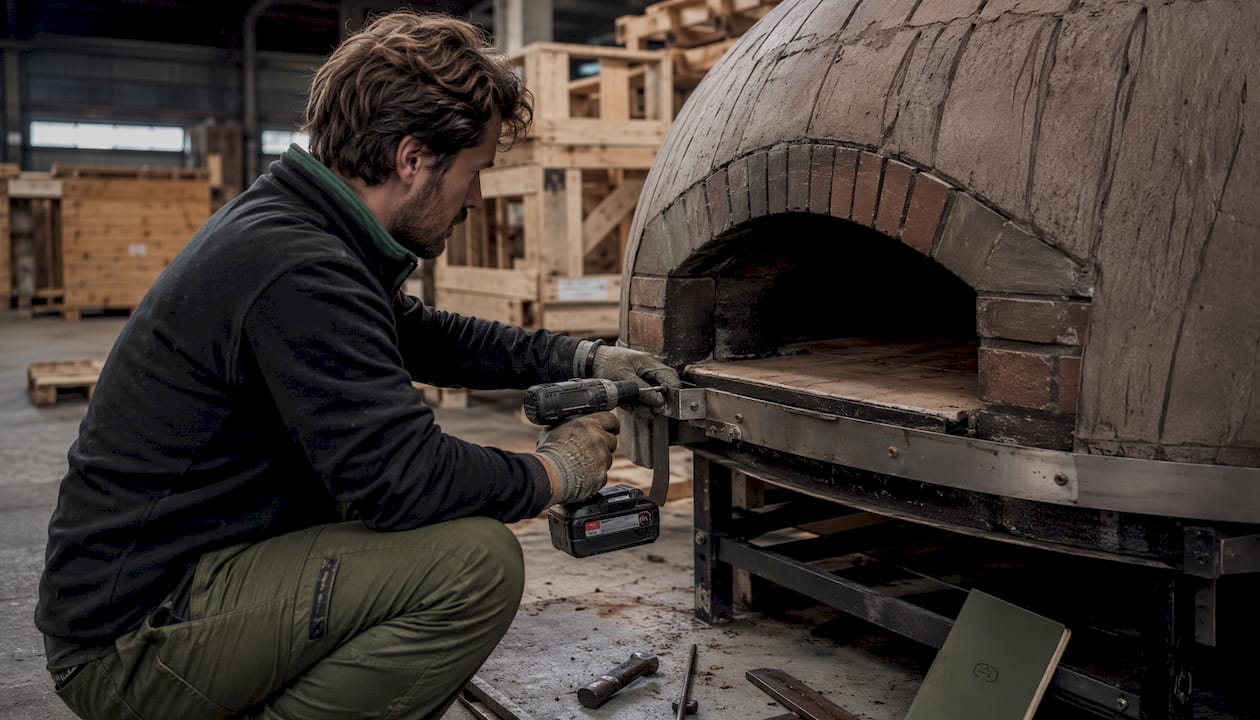
A commercial oven relocation requires a coordinated team. Each trade has a defined scope; gaps between them are where liability disputes and delays occur.
- Crane or rigger operator: holds current rigging qualifications, provides a written lift plan and method statement, carries Public Liability insurance (confirm the limit in writing).
- Specialised oven installer: ideally the manufacturer or an authorised installer; responsible for final levelling, dome inspection, and curing supervision.
- Gas Safe registered engineer: mandatory for disconnection and reconnection of any gas supply; must issue a Gas Safe certificate on completion.
- Qualified electrician: required for electric ovens or any electrical interlock; should provide a completion certificate.
- Structural engineer: needed wherever the oven sits above ground level, on a timber floor, or where the new location has unknown load-bearing capacity.
What to request in writing before work begins
- Lift plan and method statement (crane operator).
- Risk assessment covering the full route, not just the lift point.
- Copies of all insurance certificates: Public Liability, Employer’s Liability, motor and haulage.
- Gas Safe registration number and certificate template.
- Manufacturer’s signed curing schedule, confirmed before the move date is fixed.
Pro Tip: Ask each contractor whether their insurance covers masonry oven damage specifically. Standard removal and storage policies often exclude specialist catering equipment. Get the answer in writing.
Clarity on staff roles during a move matters too: hospitality team members should monitor and guide, not assist with the physical lift or utility disconnection.
How will the oven actually be moved?
The right method depends on the oven’s weight, the access route, and the destination floor level.
- Crane lift: the preferred method for restricted access, upper-floor placements, or ovens exceeding the safe working load of a standard forklift. Requires a street permit if the crane occupies a public road.
- Forklift or pallet method: suitable for ground-floor moves with adequate floor loading and clear turning space. Faster and lower cost, but only viable where the floor and access confirm it.
- Engineered dolly or hydraulic lifter: used for short repositions within the same building where crane access is impossible.
Protection and packing requirements
- Certified lifting slings rated to the oven’s gross weight, positioned at manufacturer-specified rigging points.
- Timber strapping and internal bracing to stabilise the dome during transit.
- Protective wrapping on all finished surfaces, with labelled components documented photographically before removal.
- Floor protection (hardboard or Correx sheeting) on the full travel route.
- A documented condition report at load, at delivery, and at placement — signed by the rigger and the installer.
Pro Tip: Large masonry ovens can weigh several tonnes; crane lifts are often the only practical solution. Never allow a contractor to substitute a lower-rated machine to save cost — the lift plan must match the actual weight.
Re-installation, levelling, and the curing protocol
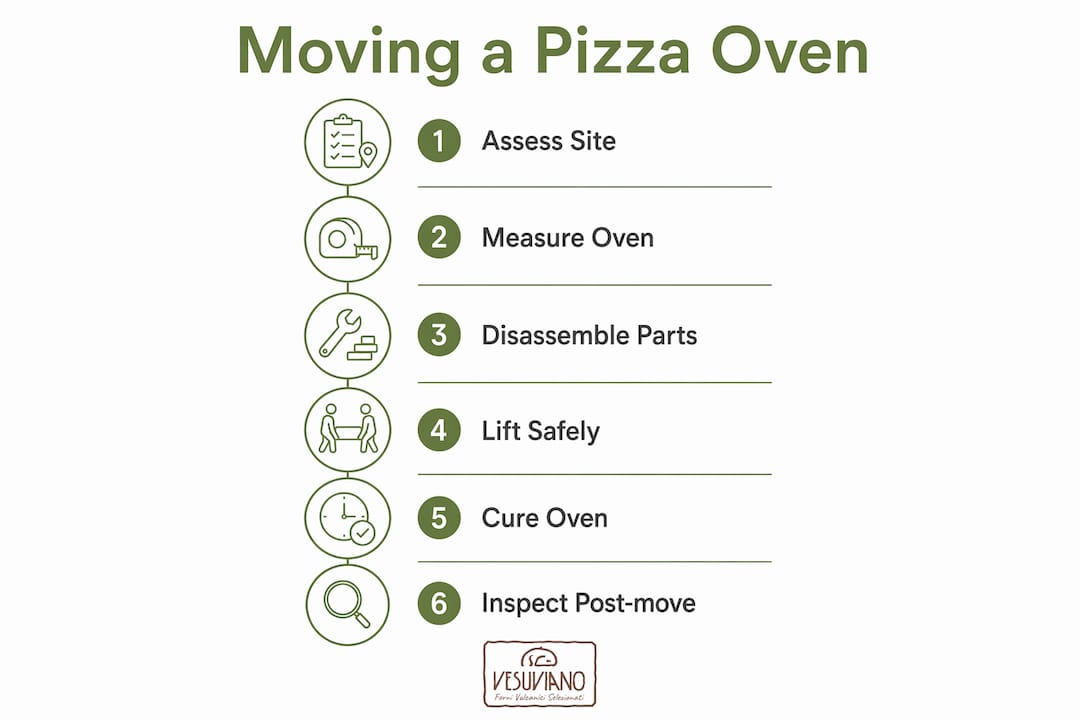
Step-by-step reinstallation
- Confirm the new base is structurally sound, level to within the manufacturer’s tolerance, and capable of bearing the full oven weight.
- Lower the oven onto the base using controlled staged lifts; do not release slings until levelling is confirmed.
- Check level on two axes; adjust base packing as required before any mechanical fixings are tightened.
- Align and secure the flue; verify clearances to combustibles and confirm ventilation meets the original specification.
- Inspect the dome and masonry for transport cracks, check hearth and floor stones for displacement, and verify fire suppression system clearances.
Curing protocol
Manufacturer-specified curing schedules are mandatory after any significant relocation of a masonry oven. Skipping them risks thermal shock and cracking when the oven is first brought to full production temperatures. Curing involves a series of gradual heat ramps, controlled and documented in a curing log, typically spanning several days before full service loads are applied. The exact schedule is manufacturer-specific; Vesuviano Forni provides this as part of its technical handover.
For temperature ramping guidance relevant to commercial oven commissioning, the technical team can advise on the correct sequence for each model.
Pro Tip: Never allow kitchen staff to “test fire” the oven before the curing schedule is complete. A single high-temperature run on a freshly relocated masonry oven can cause irreparable dome damage.
UK permits and insurance: what you must check
Regulatory checklist
| Requirement | Applies when | Who is responsible |
|---|---|---|
| LOLER compliance | Any lifting operation using equipment (crane, forklift, slings) | Crane/rigger operator |
| PUWER compliance | All work equipment used during the move | Each contractor using the equipment |
| Gas Safe sign-off | Any gas disconnection or reconnection | Gas Safe registered engineer |
| Local authority road/crane permit | Crane or vehicle staging on a public road or pavement | Principal contractor or operator |
| Structural engineer report | Upper floors, timber joists, or unknown load capacity | Structural engineer |
- Confirm Public Liability insurance limits from every contractor before work begins.
- Require Employer’s Liability certificates from any contractor bringing workers onto your site.
- Verify motor and haulage insurance covers the oven’s declared value during transport.
- Ask the manufacturer explicitly: who accepts liability for post-move curing issues if the schedule is not followed?
- Keep all permits, certificates, and signed method statements in a single project file for audit and insurance purposes.
What drives the cost and timeline of a commercial oven move?
Primary cost drivers
- Distance and route complexity (multi-floor, restricted access, or remote locations add significantly to crane and labour costs).
- Crane hire versus forklift: crane operations carry higher day rates and require a lift plan, street permit, and traffic management.
- Structural engineer reports, where required, add professional fees and lead time.
- Manufacturer on-site attendance for curing supervision is an additional cost but materially reduces post-move failure risk.
- Contingency budget for damage repair, extended curing, or aborted lifts due to access issues discovered on the day.
Typical timeline
- Pre-move survey and planning: several days to a few weeks depending on structural assessment requirements.
- Permit and lift plan approval: allow additional days to weeks for local authority and contractor sign-off.
- Physical move and reinstallation: typically hours to a full day for the lift itself; allow additional time for levelling and utility reconnection.
- Curing and commissioning: several days to a few weeks, following the manufacturer’s schedule.
Plan moves outside peak trading hours and consolidate any adjacent building works to avoid repeated access costs.
Handover checklist before the oven returns to service
- Final levelling confirmed and recorded.
- Dome and masonry inspected; no transport cracks noted or repairs documented.
- Flue alignment verified and clearances confirmed.
- Gas Safe certificate issued and filed.
- Electrical completion certificate issued (electric ovens).
- Manufacturer’s curing schedule completed and curing log signed off.
- Condition report from rigger and installer, both signed.
- Any repairs or adjustments noted in the handover file.
| Handover document | Issued by | Filed where |
|---|---|---|
| Gas Safe completion certificate | Gas Safe engineer | Project file |
| Electrical completion certificate | Qualified electrician | Project file |
| Curing log and manufacturer sign-off | Manufacturer/installer | Project file |
| Signed condition report | Rigger and oven installer | Project file |
| Lift plan closure confirmation | Crane operator | Project file |
Brief your kitchen team on any temporary operating restrictions, the oven’s return-to-temperature protocol, and the after-sales contact details for ongoing support.
Vesuviano Forni’s relocation support for UK hospitality operators
Moving a handcrafted Neapolitan oven is not simply a logistics exercise — it is a technical project that carries real warranty and performance implications. Vesuviano Forni provides the manufacturer-led oversight that protects your investment at every stage.
From the initial pre-move technical consultancy and site survey through to on-site assembly, curing supervision, and documented handover, the Vesuviano Forni team manages the process with the precision that a handcrafted oven demands. The RealBosco and Sebastian product lines, along with the patented VesuvioBuono® low-emission system, are each supported by manufacturer-specific curing protocols and after-sales assistance. For operators with emissions targets or planning constraints, the VesuvioBuono® range offers the full character of a wood-fired oven without black soot output. For those considering a commercial wood-fired oven relocation or a new installation, the team can advise on the most practical approach for your site.
Request a pre-move assessment directly from Vesuviano Forni to scope your relocation, confirm curing requirements, and receive a documented plan before any contractor is appointed.
Key takeaways
Moving a commercial pizza oven safely requires a pre-move structural assessment, qualified riggers and Gas Safe engineers, a manufacturer-supervised curing schedule, and a complete documented handover before service resumes.
| Point | Details |
|---|---|
| Book the assessment first | Engage the manufacturer and a structural engineer before appointing any contractor. |
| Hire the right trades | Riggers, Gas Safe engineer, and a structural engineer where floors are uncertain are all mandatory. |
| Follow the curing schedule | Manufacturer-specified heat ramps must be completed and logged before full production loads. |
| Secure permits and insurance | LOLER, PUWER, Gas Safe, road/crane permits, and contractor insurance must all be confirmed in writing. |
| Vesuviano Forni provides end-to-end support | Technical consultancy, on-site installation, curing supervision, and documented handover for UK operators. |
Why manufacturer involvement is the deciding factor
There is a tendency in the hospitality sector to treat an oven relocation as a standard heavy-lift job — find a removal firm, book a crane, and reconnect the gas. The reality is that a handcrafted masonry oven is a precision-built structure, and the risks that materialise after the move are almost always the ones that were not planned for before it.
The curing schedule is the clearest example. Skipping or shortening it to get back into service faster is the single most common cause of post-move dome damage. Manufacturer attendance is not a luxury; it is the mechanism by which the warranty remains valid and the oven performs as it was built to perform.
Vesuviano Forni’s artisans bring over 50 years of Neapolitan oven-building knowledge to every project, and the R&D team behind the VesuvioBuono® system applies that same rigour to post-move commissioning. When the manufacturer is present at reinstallation, the curing log is accurate, the sign-off is meaningful, and your team returns to service with confidence rather than uncertainty.
Useful UK and industry references
- Health and Safety Executive (HSE): guidance on LOLER (Lifting Operations and Lifting Equipment Regulations 1998) and PUWER (Provision and Use of Work Equipment Regulations 1998) — hse.gov.uk
- Gas Safe Register: verify engineer registration and understand legal requirements for gas work in the UK — gassaferegister.co.uk
- Local authority highways/street-works teams: contact your borough or district council for road occupation and crane staging permits before the move date is confirmed.
- Vesuviano Forni technical team: manufacturer-specific curing schedules, lift point drawings, and relocation consultancy for RealBosco, Sebastian, and VesuvioBuono® models.
| Reference | Topic | Where to consult |
|---|---|---|
| HSE LOLER/PUWER guidance | Lifting equipment obligations | hse.gov.uk |
| Gas Safe Register | Engineer verification and gas safety law | gassaferegister.co.uk |
| Local authority highways team | Road/crane permits | Your borough or district council |
| Vesuviano Forni technical team | Manufacturer curing, lift plans, sign-off | vesuvianoforni.com |