Pizza oven capacity: sizing guide for restaurants
Pizza oven capacity: sizing guide for restaurants
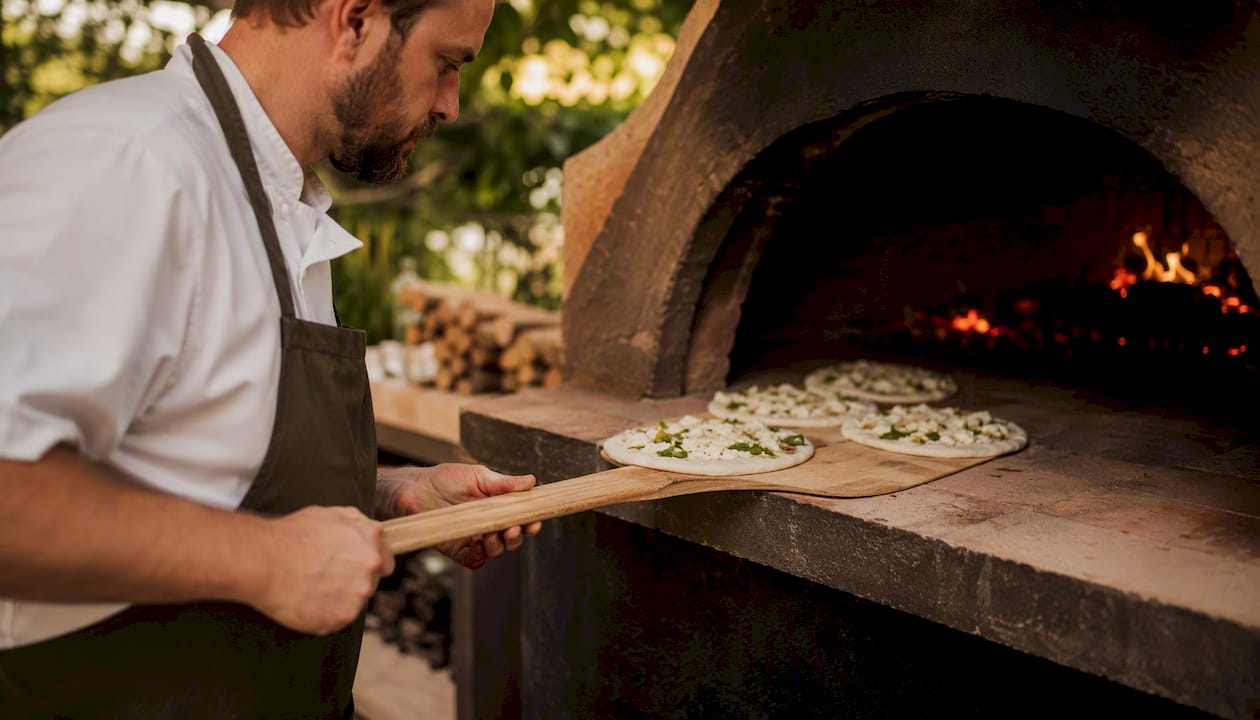
Commercial pizza oven capacity is the peak number of pizzas per hour a given oven configuration can reliably deliver under heavy-load test conditions. The formula is straightforward:
PC = Pnum × 60 ÷ t
Where PC is production capacity (pizzas/hr), Pnum is the number of pizzas loaded per cycle, and t is the total cycle time in minutes (cook time plus recovery). A single 48in deck loading four 14in pies with a 6.5-minute cycle yields roughly 37 pizzas per hour per deck. Stack three decks and that figure approaches 110 pizzas per hour, assuming independent recovery on each level.
- Pnum is derived from nominal deck depth × width, mapped against ASTM test tables.
- t includes both cook time and the recovery period before the next load can go in.
- The cycle repeats under continuous heavy-load conditions, not a single isolated bake.
Pro Tip: Size to your busiest 60 minutes, then add a 20% buffer. Sizing to your average hour is the single most common and costly mistake operators make.
Key takeaways
Sizing pizza oven capacity correctly means calculating from your peak 60-minute demand, applying the production-capacity formula, and verifying the result against heavy-load test data before you purchase.
| Point | Details |
|---|---|
| Use the PC formula | PC = Pnum × 60 ÷ t; always include recovery time in t, not just cook time. |
| Size to peak, not average | Calculate your busiest 60-minute window and add a 20% buffer to set your minimum PC target. |
| Match oven class to volume | Single deck suits 40–60 pizzas/hr; triple deck reaches 120–180/hr; conveyors scale further with belt width. |
| Demand heavy-load test data | Request ASTM or FTC-protocol results; reject any throughput claim unsupported by test conditions. |
| Vesuviano Forni | Offers RealBosco, Sebastian, and VesuvioBuono families with full technical consultancy and custom on-site builds for the US market. |
Table of Contents
- How is pizza oven capacity actually measured?
- How does oven type change your throughput?
- How do chamber dimensions map to pizzas per load?
- Worked sizing examples: applying the formula
- What operational factors reduce your real-world capacity?
- What to ask a vendor before you commit
- A manufacturer’s perspective on sizing ovens for restaurants
- Vesuviano Forni can match your capacity requirements
- Sources
How is pizza oven capacity actually measured?
The industry standard is the ASTM heavy-load test, adopted by facilities such as the Southern California Edison Foodservice Technology Center (FTC). It simulates continuous service: the oven is loaded to its rated Pnum, baked to specification, unloaded, and immediately reloaded. Measurements taken across multiple consecutive runs include:
- Pizza weight and temperature before and after baking
- Energy consumed per run (kWh)
- Cook time and recovery time per cycle
- Idle energy rate (kW) and idle duty cycle
The FTC heavy-load test of a Revent modular deck oven produced 8 pizzas per run at a cook time of 8 minutes 30 seconds, yielding a little over fifty pizzas per hour per deck. Energy consumed per run was within the range of 0.72–0.76 kWh, with a cooking energy efficiency around sixty percent. Projected across three independent decks, the ASTM production capacity estimate approaches one hundred sixty pizzas per hour.
| Metric | Revent single-deck result |
|---|---|
| Pizzas per heavy-load run | 8 |
| Cook time per run | 8 min 30 sec |
| Energy per run | 0.72–0.76 kWh |
| Cooking energy efficiency | around 60% |
| Single-deck production capacity | 56.5 pizzas/hr |
| Triple-deck ASTM estimate | 168.96 pizzas/hr |
Ambient temperature, door-opening frequency, and dough load consistency all shift the figure.
How does oven type change your throughput?
Oven class is the first decision that shapes your capacity ceiling. Each type operates on a different heat-transfer principle, and that determines both cook time and how you scale volume.
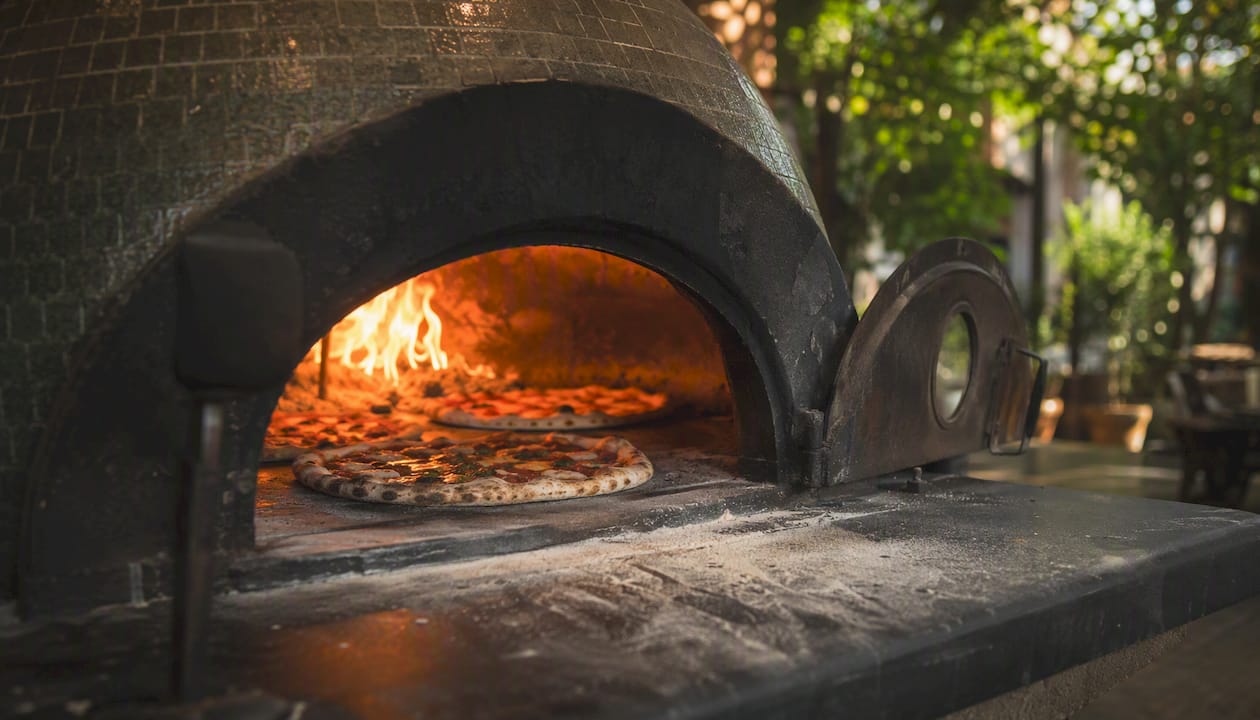
Deck ovens store heat in brick, ceramic, or steel and radiate it back to the product. That direct deck contact is what creates the charred base and open crumb characteristic of Neapolitan and New York-style pizza. Throughput scales by stacking: benchmarks for common commercial classes run at roughly 40–60 pizzas/hr for a single deck, 80–120 pizzas/hr for a double deck, and 120–180 pizzas/hr for a triple deck.
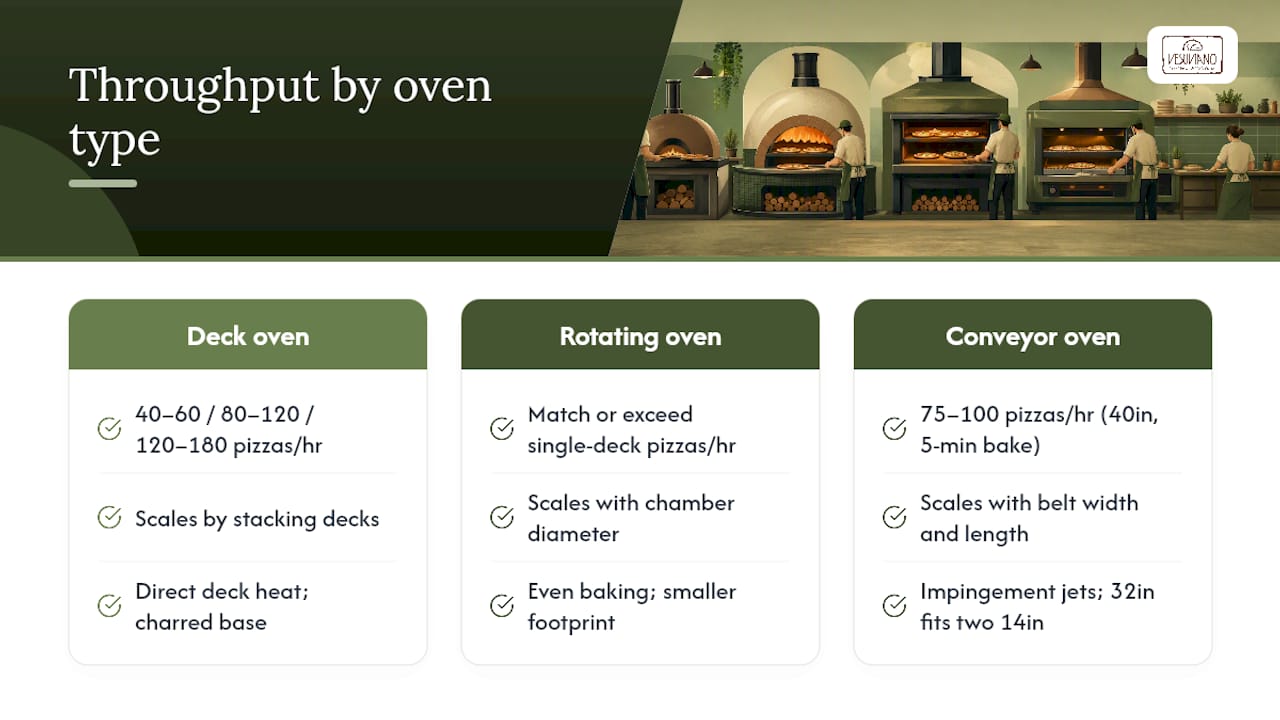
Rotating ovens (stone-hearth or dome) spin the pizza continuously through the heat zone, producing even baking without manual turning. They suit high-craft, Neapolitan-style operations and can match or exceed single-deck throughput in a smaller footprint, depending on chamber diameter.
Conveyor ovens use impingement air jets and a moving belt. A 32in belt commonly fits two 14in pizzas side by side; chamber length determines how many are baking simultaneously. A standard 40in conveyor yields roughly 75–100 14in pizzas per hour at a 5-minute bake cycle, with throughput increasing proportionally as belt width or length grows.
How do chamber dimensions map to pizzas per load?
Nominal deck depth and width are the two numbers that determine Pnum. ASTM test tables map each combination to a standard pizza count per run, treating each loading position as roughly one square foot of usable deck area.
- Measure nominal depth and width from the manufacturer’s spec sheet, not the external footprint.
- Divide each dimension by the pizza diameter (in the same unit) to find how many fit across and front-to-back.
- Multiply to get Pnum. A 48in × 48in deck with 14in pizzas fits approximately 3 × 3 = 9 pies, though real-world loading typically yields 8 due to clearance.
- Apply the formula: PC = 8 × 60 ÷ 8.5 = 56.5 pizzas/hr, matching the FTC Revent benchmark precisely.
For a deeper look at how wood-fired oven chamber dimensions translate into practical loading positions, Vesuviano Forni’s dimension guide covers the full mapping with installation clearances.
Common deck sizes and their approximate Pnum for 14in pizzas:
Worked sizing examples: applying the formula
Scenario 1 — Small neighbourhood pizzeria, 20-pie peak hour
Required: 20 pizzas/hr. A single 36in deck covers peak demand with some headroom. No stacking needed.
Scenario 2 — Full-service pizzeria, 60-pie peak hour
Required: 60 pizzas/hr × 1.20 buffer = 72 pizzas/hr. A double-deck 48in oven produces roughly double a single deck’s output and covers this comfortably, even accounting for practical variability and staff loading gaps.
Scenario 3 — High-volume delivery kitchen, 200-pie peak hour
Required: 200 × 1.20 = 240 pizzas/hr. A triple-deck configuration at the Revent benchmark (168.96 pizzas/hr) falls short alone. Supplement with a commercial rotating oven or a wide-belt conveyor. A 40in conveyor adds 75–100 pizzas/hr; a wider or stacked unit pushes that figure higher.
When projecting multi-deck performance from single-deck test data, multiply only when each deck operates independently with comparable recovery. Shared heat sources or shared loading access typically reduce the multiplicative estimate in practice.
Pro Tip: Match your dough supply to your oven throughput. A Neapolitan dough calculator helps you work out ball counts so your prep line never becomes the bottleneck.
What operational factors reduce your real-world capacity?
Lab figures are a ceiling, not a guarantee. Several factors consistently pull real throughput below the ASTM estimate.
Preheat and recovery. The Revent test recorded a preheat period to 465°F of approximately 99 minutes, consuming 7.92 kWh. An oven that has not fully recovered between loads will bake inconsistently and extend effective cycle time, cutting your hourly output.
Footprint and ventilation. US commercial kitchen codes require Type I hood coverage for ovens producing grease-laden vapour. Hood sizing, clearance distances, and make-up air requirements all affect where an oven can be placed and how large it can be. A deck oven that fits the spec sheet may not fit the hood.
Staff loading rate. A skilled pizzaiolo can load and unload a deck in under 90 seconds. An inexperienced operator may take three minutes or more, adding directly to cycle time and reducing PC. Ergonomics matter: a triple-stack deck requires loading at shoulder height, which slows the process and increases fatigue during a busy service.
Common capacity mistakes to avoid:
- Sizing to average hourly sales rather than the busiest 60-minute window
- Ignoring recovery time when calculating cycle time
- Assuming stacked decks always multiply single-deck output linearly
- Overlooking hood and ventilation constraints before purchasing
What to ask a vendor before you commit
A structured checklist prevents expensive surprises after installation.
- Measure your busiest 60 minutes. Count tickets, not covers. That number, multiplied by 1.20, is your minimum required PC.
- Request heavy-load test data. Ask specifically for ASTM or FTC-protocol results, not marketing throughput claims.
- Confirm cook time and recovery time at the stated throughput, not at a single-pizza demonstration bake.
- Check power and ventilation requirements against your existing electrical supply and hood capacity.
- Ask about service and spare parts lead times for your market. A six-week part delay during peak season is a serious operational risk.
Red flags to watch for:
- Throughput stated as “up to X pizzas/hr” with no test conditions specified
- Nominal deck dimensions listed as external rather than internal measurements
- No published test data, only a sales representative’s verbal assurance
- Recovery time omitted from the spec sheet entirely
A manufacturer’s perspective on sizing ovens for restaurants
The most persistent mistake operators make is treating capacity as a fixed number on a spec sheet rather than a variable that depends on their kitchen, their team, and their menu.
A rotating Neapolitan oven cooking at 900°F with a 90-second bake cycle produces a very different throughput profile from a deck oven running at 650°F for eight minutes, even if both carry the same “pizzas per hour” headline figure. The cook time, the recovery, the loading method, and the chamber geometry all interact. No two kitchens are identical, and no two operators load an oven the same way.
Vesuviano Forni’s three product families reflect this reality. The RealBosco models offer authentic brick-dome construction in wood-fired, gas, electric, and rotating versions, suited to operators who want genuine Neapolitan performance and are willing to invest in the craft. The Sebastian line brings the same handcrafted engineering in a contemporary metal-slat finish, practical for modern restaurant interiors where aesthetics matter as much as output. The VesuvioBuono models add a low-emission system that eliminates black soot, making wood-fired performance viable in urban sites where emissions restrictions would otherwise rule it out.
For high-volume sites or unusual footprints, a custom oven built on-site is often the most precise answer. Chamber dimensions can be specified to the centimetre, and the installation team validates throughput under real service conditions before sign-off.
Vesuviano Forni can match your capacity requirements
Getting the capacity calculation right is only half the work. The other half is finding an oven that actually delivers those numbers in your kitchen, under your service conditions, with your team.
Vesuviano Forni Neapolitan pizza ovens are handcrafted in Naples by artisans with over 50 years of construction experience, and every commercial project includes a full technical consultancy before a single brick is laid. The team assesses your peak-hour demand, kitchen footprint, ventilation constraints, and menu profile, then recommends the configuration that matches your required PC. Rotating models, stacked deck configurations, low-emission wood-fired builds, and fully custom on-site constructions are all available for the US market, with international logistics, customs clearance, and installation managed end to end. Request a capacity assessment or a quote directly from the Vesuviano Forni team to get a configuration sized to your busiest service, not a generic spec sheet.
Sources
- How to Choose the Right Commercial Pizza Oven
- Conveyor Ovens: The Definitive Guide For High‑Volume Kitchens In 2026 - Southern Select Equipment | Quality Restaurant And Bar Equipment
- Commercial Pizza Oven Buying Guide 2026: Deck vs Conveyor vs Stone‑Hearth, Capacity & FOB Prices - Grace Kitchen Equipment