Pizza oven hood requirements: the UK compliance guide
Pizza oven hood requirements: the UK compliance guide
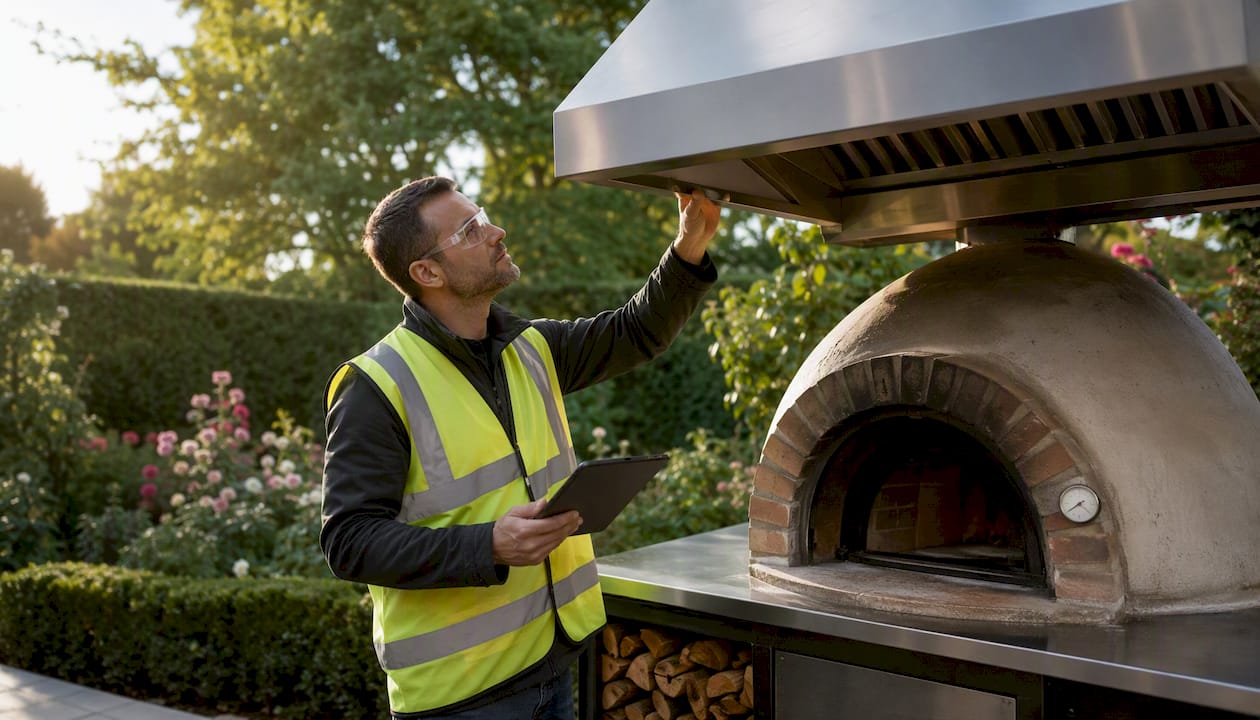
Every commercial pizza oven installed indoors in the UK requires a ventilation canopy, and in most cases that means a Type 1 exhaust hood sized to BESA DW/172. The fuel type, grease production, and whether the oven sits indoors or outdoors determine exactly what the system must include, but the non-negotiables are consistent: a correctly calculated extract rate, a dedicated make-up air supply, ductwork accessible for cleaning, and, for gas-fired appliances, a proven interlock that disables the gas supply the moment extraction fails.
Before anything else, confirm three things:
- Appliance certification: check that your oven is certified for indoor commercial use; compact or mobile units sold for outdoor use are not permitted indoors without the correct certification.
- Gas interlock: if the oven is gas-fired, a Gas Safe registered engineer must verify and commission the interlock system to IGEM/UP/19 guidance before the appliance goes live.
- DW/172-competent designer: engage a ventilation designer familiar with DW/172 coefficients before ordering ductwork or fans; under-sizing at this stage is the single most common and costly mistake on pizza-oven projects.
Table of Contents
- Does your pizza oven type actually need a hood?
- Which UK standards govern pizza oven ventilation?
- How do you calculate extract airflow for a pizza oven?
- What does a compliant pizza hood system actually include?
- Gas-fired pizza ovens: what safety measures are mandatory?
- Make-up air: why balance matters as much as extraction
- Planning, odour, and noise: what urban operators need to know
- What commissioning and maintenance records must you keep?
- What does a pizza hood installation cost in the UK?
- How Vesuviano Forni supports compliant installations
- Key takeaways
- The pitfalls experienced teams avoid on pizza hood projects
- Get your pizza oven specification right from the start
- Useful sources
Does your pizza oven type actually need a hood?
The short answer is yes for virtually every indoor commercial installation, but the specific hood type and specification depend on what the oven burns and how it is configured.
Gas and solid-fuel ovens produce grease-laden vapour, combustion products, and high radiant heat. They require a Type 1 exhaust hood, which combines grease filtration with thermal extract. There is no compliant alternative for an indoor gas or wood-fired pizza oven.
Electric ovens present a more nuanced picture. A high-output electric deck oven still generates significant heat and some grease vapour from toppings; most commercial electric pizza ovens will still require a Type 1 canopy. Lower-output electric models producing negligible grease may qualify for a Type 2 (heat and moisture only) arrangement, but this must be confirmed by a DW/172 designer based on actual appliance output, not assumed.
Conveyor and double-deck configurations change the calculation rather than the principle. DW/172 specifies multiplied coefficients for stacked or conveyor units: a double-deck gas oven uses a coefficient of 0.40 versus 0.20 for a single deck, effectively doubling the required extract volume. Stacked units may also change the canopy geometry needed to achieve effective capture.
Outdoor ovens fall outside the indoor hood rules, but they are not free from obligation. Planning permission, smoke-control area restrictions, and Environmental Health expectations around odour and neighbour impact all apply. Operators importing an outdoor-rated oven for indoor use must obtain the correct indoor certification first.
Solid-fuel ovens carry additional requirements beyond a standard Type 1 hood. DW/172 mandates spark arrestors, CO monitoring, and ductwork rated for higher temperatures than standard commercial kitchen designs. These are not optional extras; they are baseline requirements for any wood-fired installation.
Which UK standards govern pizza oven ventilation?
The primary framework is DW/172, published by BESA (the Building Engineering Services Association). Environmental Health Officers and insurers treat it as the industry benchmark for commercial kitchen ventilation design, extract calculation, canopy specification, grease separation, ductwork, make-up air, and gas interlocking. A design that cannot demonstrate DW/172 compliance will not satisfy an EHO inspection, and in many cases will void the operator’s insurance.

Sitting alongside DW/172 is EN 16282, a suite of European component standards covering hoods, fans, and ductwork. EN 16282 and DW/172 are complementary: EN 16282 sets component performance criteria, while DW/172 provides the system-level design and calculation methodology. Both may be referenced in a compliant specification.
Building Regulations engage through Part F (ventilation) and Part J (combustion appliances and fuel storage systems). For gas appliances, Part J requires adequate combustion air and safe flue arrangements. Local authority Building Control will check these at inspection.
Gas Safe Register is the statutory body for gas work in the UK. Any gas connection, interlock commissioning, or appliance certification check must be carried out by a Gas Safe registered engineer. The Gas Safe registration number must appear on all commissioning paperwork.
IGEM/UP/19 provides the design and application guidance for interlock devices on gas-fired catering equipment. It sets out flow-proving and pressure-proving requirements and specifies how the interlock panel must respond to fan failure.
The consequences of non-compliance are serious:
- Environmental Health Officers can issue prohibition notices, preventing the business from trading.
- Insurers can void fire and liability policies where ventilation does not meet DW/172.
- A gas-related incident on an uncertified or incorrectly interlocked appliance carries significant legal exposure for the operator and any engineer who signed off the installation.
DW/172 compliance is not a design preference; it is the standard EHOs and insurers will apply when assessing your kitchen. Designing to a lower specification and hoping for the best is not a viable commercial strategy.
How do you calculate extract airflow for a pizza oven?
DW/172 uses the thermal convection method to size extract. The calculation has four steps: measure the appliance plan area, apply the appropriate coefficient, sum all appliance volumes under the canopy, then apply a canopy factor to arrive at total extract flow in m³/s.
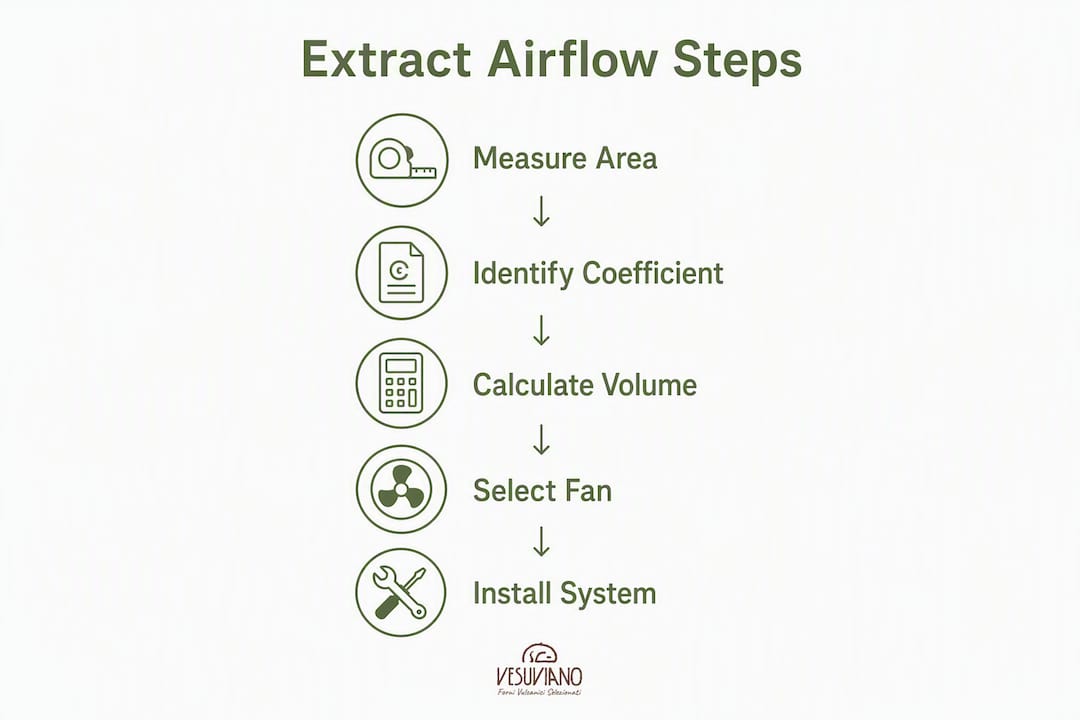
DW/172 coefficients for common pizza-oven types
| Appliance type | DW/172 coefficient | Notes |
|---|---|---|
| Stone hearth (single) | 0.45 | Highest coefficient in the pizza-oven category |
| Gas deck, single | 0.20 | Double the value for a stacked pair |
| Gas deck, double | 0.40 | Pre-multiplied; do not apply ×2 again |
| Single-deck conveyor | 0.40 | Apply ×2 for double-deck conveyor |
| Double-deck conveyor | 0.45 | Pre-multiplied coefficient |
Source: DW/172 BESA coefficients table
Worked example: single stone hearth oven
A stone hearth oven with a plan area of 1.2 m² sits under a wall-mounted canopy (canopy factor 1.0):
- Extract volume = plan area × coefficient = 1.2 × 0.45
- Apply wall canopy factor (1.0): total extract calculated accordingly
Worked example: double-deck gas oven
A double-deck gas oven with a plan area of 1.0 m² under an island canopy (canopy factor 1.4):
- Extract volume = 1.0 × 0.40 = 0.40 m³/s
- Apply island canopy factor (1.4): total extract calculated accordingly
These figures feed directly into fan selection and filter sizing. A backward-curved centrifugal fan is the standard choice for pizza-oven extract; it handles the elevated temperatures and grease loading better than forward-curved alternatives.
Pro Tip: Capture height matters as much as extract volume. DW/172 recommends a maximum distance of 600 mm between the top of the appliance and the underside of the canopy for a wall-mounted hood. Exceeding this height forces you to increase extract rates significantly to maintain effective capture, which drives up fan size, noise, and energy cost.
The canopy must also overhang the appliance on all open sides, typically by 150–300 mm for a wall canopy and more for an island configuration. Confirm overhang dimensions with your designer before the canopy is fabricated.
What does a compliant pizza hood system actually include?
A compliant extraction system for a pizza oven is more than a box above the appliance. Each component must be specified, installed, and commissioned as part of an integrated system.
Canopy geometry
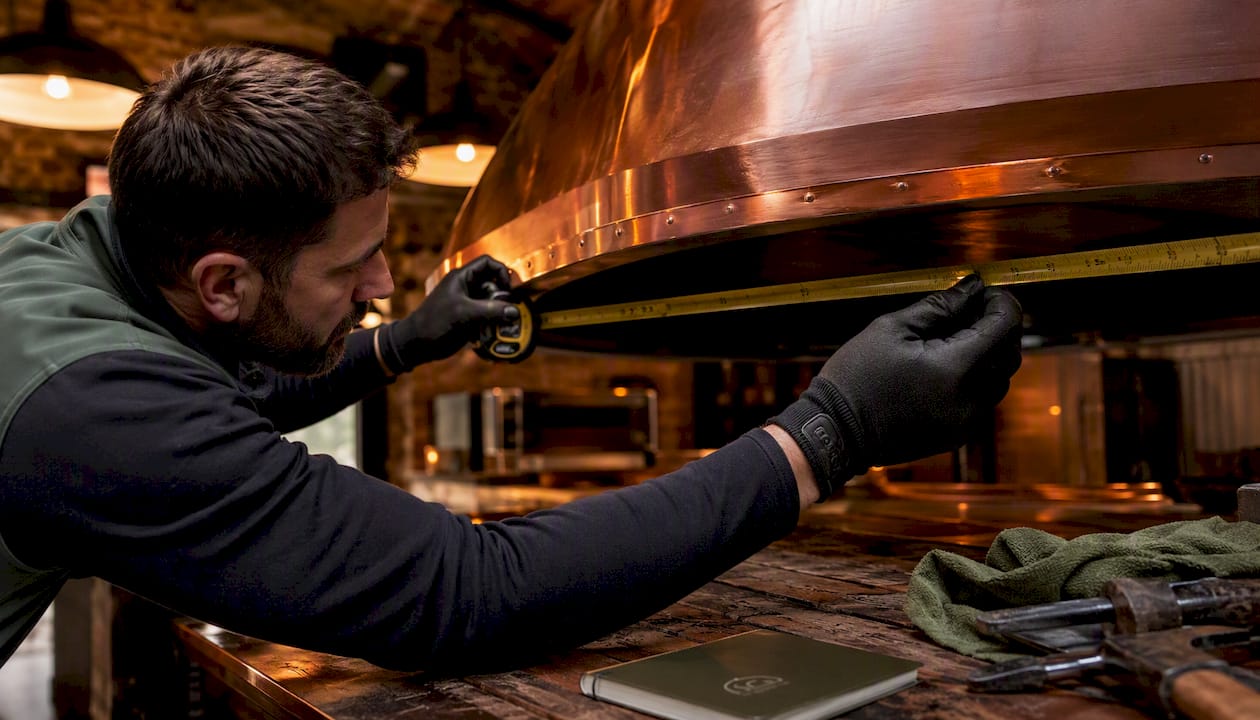
The canopy must overhang the appliance on all exposed sides to capture rising thermal plumes. Wall-mounted canopies typically require 150–300 mm overhang; island canopies need overhang on all four sides and a higher extract rate to compensate for cross-draughts. Mounting height should not exceed 600 mm above the appliance top for standard installations.
Grease filtration
Baffle filters are the standard for pizza-oven canopies. They must be rated to LPS 1263 where fire risk is elevated, particularly for solid-fuel ovens. Grease traps or collection channels below the filter bank must be accessible and cleaned regularly. Filter banks should be sized to match the calculated airflow without excessive face velocity, which causes grease carry-over into the ductwork.
Fans
Backward-curved centrifugal fans are the correct choice for pizza-oven extract. They tolerate the high temperatures and grease-laden air that axial fans cannot handle reliably over time. Fan duty must match the calculated extract rate with an appropriate system resistance allowance. For solid-fuel ovens, fans must be rated for the higher flue temperatures involved.
Ductwork and discharge
Ductwork must be constructed to DW/144 grease-tight standards with welded seams and access panels at maximum 3-metre intervals for cleaning. Where ductwork passes through fire-rated compartments, fire-rated sections or fire dampers are required under Building Regulations. Discharge must terminate at a point where exhaust cannot re-enter the building through windows, air intakes, or neighbouring openings.
Pro Tip: Specify access panels at every change of direction and at the base of any vertical riser. Inspectors and cleaning contractors will check for these at commissioning and during routine audits. Missing access points are one of the most common reasons a system fails an EHO inspection.
Materials
AISI 304 stainless steel is the standard for canopy and ductwork construction. AISI 316 is specified where the environment is corrosive or where the installation is near coastal conditions. For solid-fuel pizza ovens, ductwork must be rated for the higher operating temperatures that wood combustion produces; standard commercial ductwork is often insufficient without specific adaptation.
Gas-fired pizza ovens: what safety measures are mandatory?
Gas interlocking is not optional. IGEM/UP/19 guidance requires that the gas supply to a catering appliance is disabled automatically if the extract or supply fans fail. This is achieved through flow-proving or pressure-proving sensors connected to an interlock panel, which cuts the gas solenoid valve on fan failure.
The mandatory elements of a gas pizza oven installation are:
- Gas Safe registered engineer: all gas connections, appliance certification checks, and interlock commissioning must be carried out by a Gas Safe registered engineer. Their registration number must appear on the commissioning certificate.
- Interlock panel with flow or pressure proving: the panel must receive a proven signal from the extract fan before allowing gas to flow. Pressure proving (a differential pressure switch across the fan) or flow proving (an airflow switch in the duct) are both acceptable under IGEM/UP/19.
- Automatic gas shut-off on extraction failure: if the fan stops or the duct is blocked, gas must be cut within the time specified in the interlock design. This protects against CO accumulation and is a condition of most commercial kitchen insurance policies.
- CO and CO2 monitoring: carbon monoxide detectors should be positioned in the kitchen at breathing height. For solid-fuel ovens, CO monitoring is a DW/172 requirement. For gas ovens, it is strongly recommended by HSE guidance and increasingly required by insurers.
- Commissioning documentation: the Gas Safe engineer must issue a commissioning certificate confirming appliance certification, inlet pressure, flue arrangement, and interlock verification. This document must be retained on site.
Retrofitting an interlock after installation is significantly more expensive and disruptive than specifying it correctly from the outset. The interlock panel, wiring, and proving devices must be integrated into the extract system design, not bolted on as an afterthought when an inspector raises a concern.
Make-up air: why balance matters as much as extraction
Extraction without replacement air creates negative pressure in the kitchen. The practical consequences are doors that are difficult to open, smoke spillage when the oven door is opened, and reduced capture efficiency at the canopy. In severe cases, negative pressure can cause combustion products to back-draft from the oven flue into the kitchen.
Practitioners recommend tempered make-up air sized to replace most of the extracted volume to maintain a slight negative pressure relative to the dining area (preventing cooking odours from migrating front-of-house) while avoiding the problems of severe under-supply.
A well-designed make-up air system includes:
- Tempering: make-up air should be conditioned to avoid cold draughts across the cooking line in winter. A direct-fired or indirect-fired air handling unit is the standard approach for larger kitchens.
- Distribution: supply air should be introduced at high level, away from the canopy face, to avoid short-circuiting the extract. Perforated ceiling diffusers or plenum-fed slot diffusers work well in pizza-kitchen configurations.
- Dampers and VAV control: variable air volume staging allows the system to modulate extract and supply together, maintaining balance across different operating modes (full service, prep, closed).
Pro Tip: Specify the make-up air system and the extract system with the same designer and commission them together. Systems designed and installed by separate contractors without a co-ordinated commissioning process almost always produce balancing problems that are expensive to resolve after handover.
Planning, odour, and noise: what urban operators need to know
Failing to address odour and noise is one of the most common reasons pizza-oven installations face planning delays or refusals, even when the ventilation design is technically sound. Environmental Health Officers increasingly require operators to demonstrate mitigation before granting approval, particularly in dense urban locations.
Odour control
Standard baffle filtration does not remove odour. Where the discharge point is close to residential properties, planning authorities typically require one or more of the following:
- Carbon filtration: activated carbon modules installed in the duct downstream of the grease filters. Carbon beds require regular replacement (typically every 6–12 months depending on usage).
- Electrostatic precipitators (ESP): high-voltage plates that capture sub-micron grease particles and reduce odour significantly. ESPs require regular cleaning but offer lower ongoing consumable costs than carbon.
- UV-C ozone systems: ultraviolet lamps that break down odour compounds in the exhaust stream. Often combined with carbon for a two-stage approach where planning conditions are strict.
Noise control
Fan noise transmitted through the duct and radiated from the discharge terminal is a frequent source of neighbour complaints. Planning guidance and noise/odour control documents often specify NR (Noise Rating) targets at the nearest noise-sensitive receptor. Mitigation measures include:
- Duct attenuators (splitter or circular silencers) positioned between the fan and the discharge terminal.
- Anti-vibration mounts on the fan to prevent structure-borne noise transmission.
- Discharge terminal selection: low-velocity terminals reduce aerodynamic noise at the point of discharge.
When to prepare a formal assessment: if the proposed discharge point is within 10 metres of a residential window, or if the premises are in a conservation area or near a listed building, commission an odour and noise assessment before submitting a planning application. Presenting a mitigation scheme proactively is far more effective than responding to objections after submission.
What commissioning and maintenance records must you keep?
A compliant installation does not end at switch-on. DW/172 and industry guidance require documented commissioning records and accessible ductwork as conditions of a compliant handover.
At handover, the installer must provide:
- As-installed extract and make-up air flow measurements (in m³/s or m³/h), confirming the system meets the designed rates.
- Fan performance curves and motor data sheets.
- Interlock verification record: documented proof that the gas solenoid closes on fan failure.
- Duct access panel schedule: a drawing or schedule showing the location of every access panel.
- Gas Safe commissioning certificate (gas ovens).
- A signed handover certificate confirming the system has been commissioned to DW/172.
Ongoing maintenance schedule:
- Canopy and baffle filters: clean weekly in high-volume pizza operations; fortnightly minimum for moderate use. Grease build-up in filters is a fire risk and reduces capture efficiency.
- Ductwork: full duct clean at intervals determined by grease loading, typically every 6–12 months for pizza ovens. A TR19 grease report (issued by a specialist duct-cleaning contractor) provides documented evidence for insurers and EHOs.
- Grease separators and traps: inspect and empty monthly; more frequently during peak periods.
- Fan and motor: annual inspection of bearings, belt tension (if applicable), and impeller condition.
- Gas interlock: annual functional test by a Gas Safe engineer, with the result recorded on the maintenance log.
Retain all commissioning paperwork, Gas Safe certificates, TR19 reports, and cleaning logs on site and make them available to EHOs and insurers on request. A missing cleaning log is treated as evidence of non-compliance, regardless of the actual condition of the ductwork.
What does a pizza hood installation cost in the UK?
Budget expectations vary considerably depending on oven type, duct run length, and whether odour or noise control is required. The figures below reflect typical market ranges for UK commercial installations in 2026; actual costs depend on site conditions and specification.
| System type | Typical supply and install cost | Lead time |
|---|---|---|
| Small wall canopy + fan (electric oven, short duct run) | — | 4–6 weeks |
| Standard Type 1 canopy + extract + make-up air (gas oven) | — | 6–10 weeks |
| Odour control addition (carbon or ESP stage) | — | 2–4 weeks additional |
| Noise attenuation package | — | 1–3 weeks additional |
Costs are indicative and exclude VAT, structural works, and planning fees.
Factors that extend both cost and programme include: solid-fuel adaptations (high-temperature ductwork, spark arrestors), long duct runs requiring fire-rated sections, planning objections requiring revised discharge locations, and restricted rooftop access requiring specialist lifting equipment. Identifying these constraints at the design stage, before fabrication begins, is the most reliable way to protect the budget and the opening date.
How Vesuviano Forni supports compliant installations
Specifying the oven and the ventilation system in isolation from each other is a common source of problems. Vesuviano Forni works with operators, designers, and installers from the earliest stage of a project to ensure the oven specification and the ventilation design are developed together.
The services relevant to UK compliance include:
- Certified oven supply: all Vesuviano Forni commercial ovens are supplied with technical documentation confirming appliance specifications, plan dimensions, fuel type, and operating temperatures. These are the inputs a DW/172 designer needs to begin the extract calculation.
- Bespoke on-site construction: for projects where a standard oven footprint does not suit the kitchen layout, Vesuviano Forni’s artisans can build the oven directly on site, co-ordinating with the ventilation contractor on canopy geometry and duct connection points.
- Technical specification support: the Vesuviano Forni technical team can provide appliance-level data to support DW/172 calculations and IGEM interlock specifications, and can liaise with Gas Safe engineers during commissioning where the installation involves a gas-fired model.
- Installation oversight and documentation: at handover, Vesuviano Forni provides installation records and technical data sheets that form part of the commissioning file the operator retains for EHOs and insurers.
For operators considering a commercial wood-fired pizza oven with the additional solid-fuel requirements that entails, or a low-emission VesuvioBuono system that reduces odour and planning risk, the technical team can advise on the specific ventilation implications before the project is committed.
Pro Tip: Prepare four pieces of information before your first specification call: the appliance plan area (length × width in metres), the fuel type, the proposed installation location (indoor/outdoor, floor level, proximity to residential), and any known planning constraints. With these in hand, a DW/172 designer can produce a preliminary extract calculation and Vesuviano Forni can confirm the correct oven specification within a single briefing.
Key takeaways
Every indoor commercial pizza oven in the UK requires a Type 1 exhaust hood sized to DW/172, with a gas interlock for gas-fired models, tempered make-up air sized to replace most of the extracted volume, and documented commissioning records retained for EHOs and insurers.
| Point | Details |
|---|---|
| Hood requirement | All indoor commercial pizza ovens need a Type 1 canopy; fuel type and configuration determine the exact specification. |
| DW/172 calculation | Use the thermal convection method: plan area × coefficient × canopy factor; stone hearth coefficient is 0.45, gas deck single is 0.20. |
| Gas interlock | Gas-fired ovens must have a proven interlock (IGEM/UP/19) that cuts gas supply on fan failure; commission with a Gas Safe engineer. |
| Make-up air balance | Supply tempered make-up air sized to replace most of the extracted volume to prevent negative pressure and smoke spillage. |
| Vesuviano Forni | Supplies certified commercial ovens with full technical data for DW/172 calculations and offers bespoke on-site builds with installation oversight. |
The pitfalls experienced teams avoid on pizza hood projects
The most persistent problem on pizza-oven ventilation projects is not ignorance of the standards; it is the sequence in which decisions get made. Operators often select and order the oven, agree a kitchen layout, and only then ask a ventilation contractor to fit a hood around what is already fixed. By that point, the canopy height may be compromised by a ceiling beam, the duct route may require a fire-rated section nobody budgeted for, and the discharge point may be directly above a neighbour’s window.
Experienced teams start with the appliance specification and the ventilation design simultaneously. The oven’s plan area, fuel type, and operating temperature are the inputs the DW/172 designer needs on day one. Getting those figures from the oven supplier before the kitchen layout is finalised means the canopy geometry, duct route, and discharge location can all be designed in rather than retrofitted.
Gas interlock wiring is another area where late decisions cause disproportionate cost. The interlock panel needs a power supply, a signal from the extract fan’s airflow or pressure sensor, and a switched output to the gas solenoid valve. If the electrical first-fix has already been completed when the interlock requirement is identified, the remedial wiring work can cost more than the panel itself.
On one recent project, a restaurant operator had specified a discharge point at low level on the rear elevation, which was standard practice for the previous tenant’s light-duty extraction. When the pizza oven was installed and the Environmental Health Officer visited, the discharge location was immediately flagged: it was 4 metres from a residential window and at the wrong height for the odour loading a wood-fired oven produces. The system had to be redesigned with a vertical riser to roof level and a carbon filtration stage added. The delay cost six weeks and a significant sum in additional works. Had the discharge location been assessed at design stage, the riser and carbon stage would have been included in the original tender, at a fraction of the retrospective cost.
The lesson is straightforward: treat the ventilation system as part of the oven specification, not a separate trade package to be resolved later.
Get your pizza oven specification right from the start
Choosing the right oven and designing a compliant extraction system are decisions that belong together, not in sequence. Vesuviano Forni’s Neapolitan pizza ovens are supplied with full technical documentation, including plan dimensions, fuel specifications, and operating temperatures, giving your DW/172 designer everything needed to size the extract system accurately from day one.
Whether you are specifying a gas deck oven, a commercial rotating model, or a bespoke wood-fired build constructed on site, the Vesuviano Forni technical team can provide appliance-level data to support your ventilation contractor and Gas Safe engineer throughout the project. The team can also advise on low-emission options that reduce odour loading and simplify planning approval in urban locations.
To start a specification enquiry, prepare your appliance plan area, fuel type, proposed location, and any known planning constraints, then contact the Vesuviano Forni team directly through the website. A technical briefing can typically be arranged within a few days, and the team will confirm the correct oven specification and provide the documentation your ventilation designer needs to proceed.
Useful sources
The standards and guidance below are the primary references for designers, installers, and inspectors working on commercial pizza-oven ventilation in the UK.
- Control of odour and noise from commercial kitchen exhaust systems — planning guidance on capture velocities, discharge heights, and odour mitigation stages.