Pizza oven maintenance: a practical guide for operators
Pizza oven maintenance: a practical guide for operators
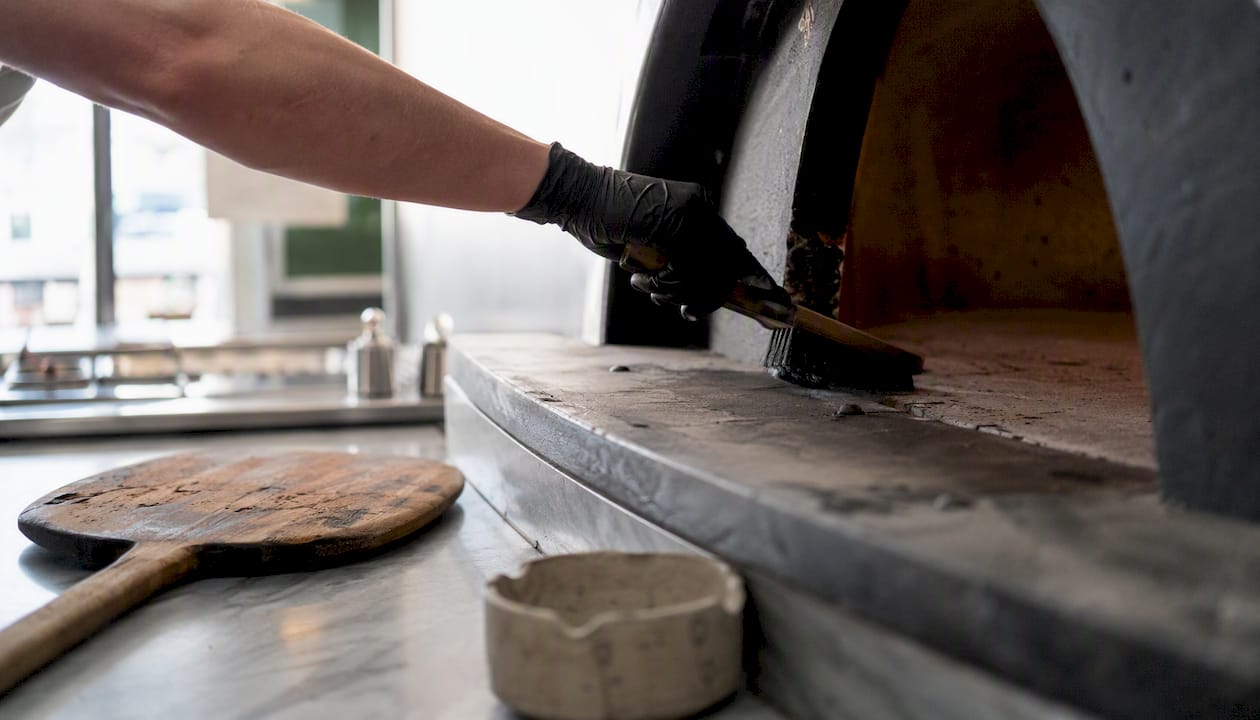
Every commercial pizza oven needs daily debris removal, weekly cleaning, and at least one professional service per year — more frequently for gas models or high-volume operations. Well-maintained commercial ovens can operate efficiently for 15–20 years; neglected equipment often fails within 5–7 years. The difference is almost entirely down to discipline and routine.
Here is what your pizza oven maintenance schedule should cover at a minimum:
Daily
- Brush the hearth while the oven is warm (not hot) and remove ash or food debris
- Empty crumb trays on gas and electric models
- Wipe accessible exterior surfaces and check the door seal visually
Weekly
- Allow the oven to cool fully, then scrape the deck and wipe interior walls
- Check ventilation intakes and hood for grease accumulation
- Inspect door hinges and gaskets; lubricate door mechanisms
Monthly
- Run a temperature consistency check across the deck
- Clean burner ports on gas ovens (with gas isolated)
- Lift and inspect the hearth stone for cracks or uneven wear
Annual (professional service required)
- Full gas-pressure test and burner calibration (Gas Safe registered engineer for gas ovens)
- Flue sweep and extraction inspection
- Insulation and refractory inspection
- Seal and gasket replacement where needed
- Electrical safety check for electric models
DIY vs. professional tasks at a glance
Operators can safely handle daily brushing, ash removal, crumb tray emptying, exterior wipe-downs, weekly deck scraping, and visual gasket checks. Anything involving gas connections, gas-pressure adjustment, flue work, electrical components, or cracked refractory must go to a qualified engineer. For gas ovens, that means a Gas Safe registered engineer — no exceptions.
Key takeaways
A well-maintained commercial pizza oven, serviced annually by a qualified engineer and cleaned consistently by trained staff, can deliver reliable performance for 15–20 years.
| Point | Details |
|---|---|
| Daily debris removal | Brush the hearth while warm and empty crumb trays every shift to prevent build-up. |
| Inspect seals regularly | Use the dollar-bill test monthly; a free-moving note means the gasket needs replacing. |
| Never use caustics on stone | Caustic cleaners strip the patina that protects heat retention and cooking performance. |
| Annual professional service | Gas ovens require a Gas Safe registered engineer; electric and wood-fired ovens benefit equally from annual inspection. |
| Keep a maintenance log | Records support warranty claims, insurance submissions, and environmental health inspections. |
| Vesuviano Forni support | Authorised after-sales, OEM spare parts, and calibration services are available for all Vesuviano oven families. |
Table of Contents
- What does a proper pizza oven maintenance inspection cover?
- Daily and weekly operator routines you can carry out safely
- How to deep clean each oven type without causing damage
- Common faults and how to troubleshoot them
- How to choose and book a professional pizza oven service
- Ventilation, extraction, and fire safety for pizza ovens
- A maintenance schedule and log template you can use today
- Manufacturer guidance from Vesuviano Forni
- The maintenance mistakes operators keep making
- Vesuviano Forni after-sales and authorised servicing
- Sources
What does a proper pizza oven maintenance inspection cover?
A structured inspection routine is the difference between catching a worn seal before it costs you heat and discovering a cracked hearth mid-service. Preventive maintenance detects wear early, preserves cooking consistency, and reduces unexpected downtime during peak trading hours — which makes it a business strategy, not just a housekeeping task.
Daily and weekly checks
- Hearth and stone: look for new cracks, discolouration, or uneven carbon deposits
- Door seals and gaskets: visual check for fraying, compression loss, or gaps
- Burners and ignition (gas): confirm clean ignition, steady blue flame, no yellow tipping
- Control panels and thermostats: verify readings match expected operating temperatures; flag erratic displays
- Ventilation intakes: clear of grease film or blockage
- Crumb trays (gas/electric): empty and wipe clean each shift
Monthly and quarterly checks
- Temperature consistency: use a calibrated infrared thermometer to map the deck surface; a variance of more than 20–25°C across the stone warrants investigation
- Burner port condition: inspect ports for carbon build-up; clean with a soft brass brush after isolating the gas supply
- Gasket integrity (dollar-bill test): slide a folded note between the door gasket and the frame at several points around the perimeter. If the paper moves freely, the seal is compromised and should be replaced — a failed gasket causes heat loss and uneven bakes
- Stone lift inspection: every 6–8 months, lift the hearth stone and vacuum beneath it to remove accumulated debris and check the insulation layer below
Annual items requiring a technician
The following should appear on every annual service booking:
- Gas-pressure test and full burner calibration
- Flue and chimney sweep (HVAC contractor or specialist)
- Refractory and insulation inspection
- Full electrical safety check (electric ovens)
- Thermostat and control calibration
- Replacement of worn seals, gaskets, and any cracked components
Safety reminder: always isolate the gas supply at the isolation valve and switch off electrical power at the mains before carrying out any deep inspection or cleaning beyond a visual check. Never assume an oven is safe to work on simply because it has been switched off at the control panel.
Daily and weekly operator routines you can carry out safely
Consistency is what keeps a commercial oven reliable. Daily brushing, ash removal, and weekly deck scrapes prevent the creosote and grease build-up that leads to uneven heat, off-flavours, and costly repairs. These steps are straightforward, but the order and method matter.
Daily routine (end of service)
- Allow the oven to drop to a warm but touchable temperature before working inside it.
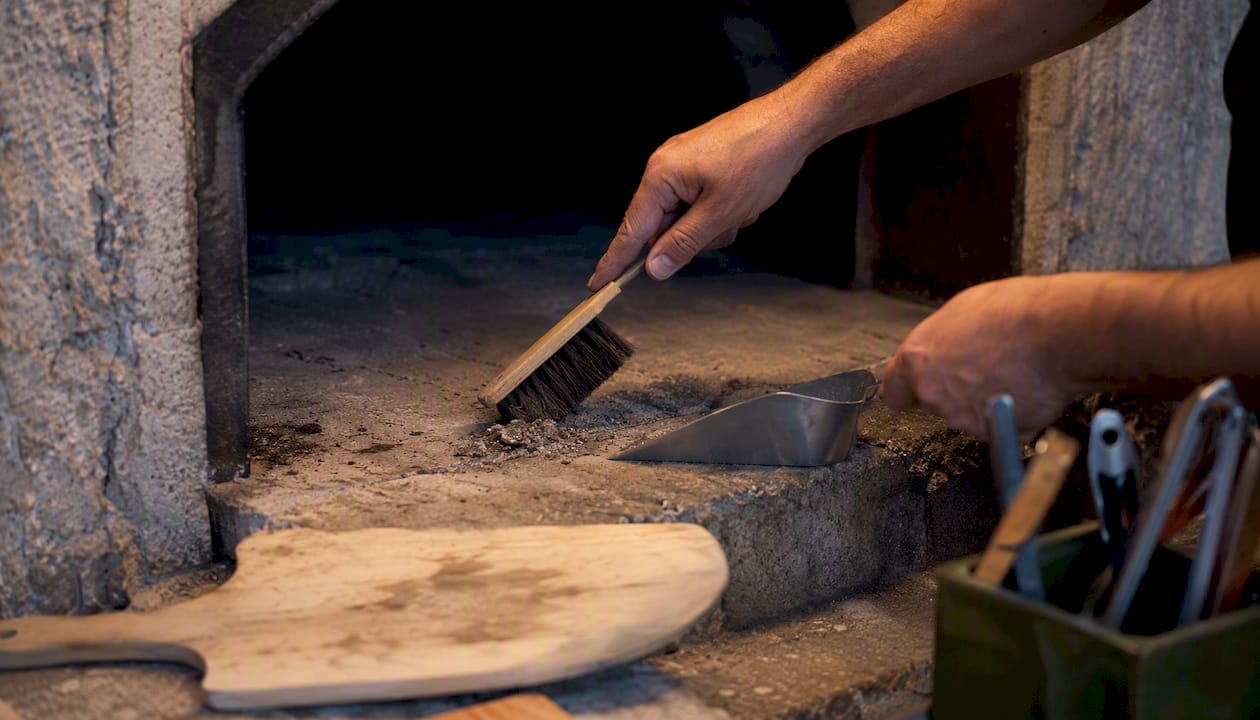
- Use a long-handled natural-bristle brush to sweep ash and food debris from the hearth toward the door opening, then remove with a metal ash shovel.
- For gas and electric ovens, pull and empty the crumb tray; wipe it with a dry cloth before replacing.
- Wipe down the door glass (if fitted) and exterior surfaces with a damp cloth and mild detergent; dry immediately.
- Check the door seal visually for any new damage and confirm the door closes flush.
- Log the check: date, operator name, and any observations.
Weekly routine (cool oven, start of week)
- Allow the oven to reach full ambient temperature — never clean a stone with cold water when it is still warm.
- Use a flat-edged metal scraper to remove carbonised food from the deck surface; work gently and avoid gouging.
- Wipe interior walls with a dry or very slightly damp cloth; no chemical cleaners on refractory surfaces.
- Inspect the hood and ventilation duct for grease film; wipe accessible surfaces with a food-safe degreaser.
- Lubricate door hinges and locking mechanisms with a food-safe, heat-resistant lubricant.
- For wood-fired ovens, check the ash drawer or ash pit and clear any compacted ash that could restrict airflow.
PPE for all cleaning tasks: heat-resistant gloves rated for the temperatures involved, safety glasses when scraping or brushing, and a dust mask when removing ash from wood-fired ovens. Never use water directly on a hot or warm hearth stone — thermal shock can crack it.
Pro Tip: Sweeping the hearth while the oven is still warm (not hot) makes ash removal significantly easier and prevents fine ash from bonding to the stone surface. Operators who do this consistently spend far less time on monthly deep cleans.
How to deep clean each oven type without causing damage
Deep cleaning methods differ meaningfully between wood-fired, gas, and electric ovens. Using the wrong product or technique on the wrong surface is one of the most common causes of premature wear. Using water on a hot stone or applying abrasive caustic cleaners to refractory surfaces are among the most frequently documented cleaning mistakes — both cause damage that is difficult and expensive to reverse.
Wood-fired ovens
- Allow the oven to cool completely to ambient temperature — at least 12 hours after the last fire.
- Remove all ash with a metal shovel and a natural-bristle brush; dispose of ash safely in a metal container with a lid.
- Scrape the hearth stone with a flat metal scraper to remove carbonised food; use light, even strokes.
- Wipe the stone with a dry cloth. If stubborn carbon remains, a damp (not wet) cloth is acceptable on a fully cold stone.
- Clean the interior dome walls with a dry brush only; do not apply any chemical cleaner to the refractory brick.
- Inspect the flue opening for soot or creosote deposits; if visible build-up is present, arrange a professional flue sweep.
What to avoid: caustic oven cleaners, bleach, acidic descalers, wire brushes on the stone surface, and pressure washing. These strip the natural patina that develops on the stone over time. Preserving that patina is critical for heat retention and cooking performance in Neapolitan ovens — it is not dirt; it is a functional cooking surface.
Gas ovens
- Isolate the gas supply at the isolation valve before any internal cleaning.
- Remove burner assemblies according to the manufacturer’s instructions; clean ports with a soft brass brush and compressed air.
- Wipe beneath the burners with a food-safe degreaser and dry cloth; remove any grease pooling.
- Clean the deck stone as described above (cool, dry or slightly damp cloth, no caustics).
- Wipe the interior walls and door frame with a food-safe, non-caustic cleaner; rinse and dry thoroughly.
- Reassemble burners, restore gas supply, and test ignition before returning the oven to service.
A yellow or orange flame tip after cleaning indicates incomplete combustion — usually a partially blocked burner port. Clean the port again or call a Gas Safe engineer if the issue persists.
Electric ovens
- Isolate the power supply at the mains before any internal work.
- Remove the hearth stone carefully; clean it separately with a dry cloth or, if cold, a slightly damp cloth.
- Vacuum the interior cavity with a dry vacuum to remove crumbs and debris; do not use wet cleaning methods near heating elements.
- Wipe interior walls with a barely damp cloth and a food-safe cleaner; dry immediately and thoroughly.
- Inspect heating elements visually for damage, discolouration, or carbon deposits; do not scrape elements directly.
- Replace the stone, restore power, and run a short heat cycle to confirm even temperature distribution before service.
Safe products for all oven types: food-grade degreasers (such as those certified to BS EN 1276), natural-bristle brushes, long-handled flat scrapers, and dry microfibre cloths. Avoid steel wool, wire brushes on stone, and any cleaner containing sodium hydroxide (lye) or strong acids on refractory surfaces.
Common faults and how to troubleshoot them
Most pizza oven faults follow recognisable patterns. Knowing the likely cause saves time and helps you decide quickly whether to fix it in-house or call an engineer.
| Symptom | Likely cause | Immediate action | Call an engineer when |
|---|---|---|---|
| Won’t ignite (gas) | Blocked burner port, faulty igniter, or gas supply issue | Check gas isolation valve is open; clean burner port; test igniter spark | No spark after cleaning, or gas smell present |
| Uneven heat across deck | Cracked stone, failed burner section, or thermostat fault | Run infrared temperature map; inspect stone for cracks | Stone cracked, burner section dead, or thermostat unresponsive |
| Slow heat-up | Damaged insulation, worn door seal, or blocked flue | Dollar-bill gasket test; visual flue check | Insulation suspected; flue blockage confirmed |
| Excessive smoke (wood) | Wet wood, blocked flue, or creosote build-up | Switch to dry hardwood; check flue draw | Flue blockage or creosote confirmed |
| Strange noises | Loose component, thermal expansion, or fan fault | Identify source; check for loose panels or fan blades | Fan motor fault or structural noise |
| Gas smell | Gas leak at connection or valve | Isolate gas immediately; ventilate; do not use electrical switches | Always — a gas smell is always an engineer call |
| No power (electric) | Tripped circuit breaker or element failure | Check and reset circuit breaker | Element failure or persistent tripping |
PMQ’s operator data shows the most common deck-oven fault is failure to hold temperature, while conveyor ovens most commonly present with complete power loss — both are preventable with consistent cleaning and seal maintenance.
A gas smell must be treated as an emergency. Isolate the gas supply, open windows and doors, evacuate the area, and call a Gas Safe engineer before the oven is used again. Do not attempt to locate the leak yourself.
How to choose and book a professional pizza oven service
Annual professional servicing is not optional for gas ovens in a commercial setting — it is a safety and regulatory requirement. For wood-fired and electric ovens, annual servicing is strongly recommended to protect warranty, maintain insurance compliance, and catch wear that daily checks will miss.
What a full service should include
- Full internal inspection: refractory, insulation, seals, and door mechanism
- Burner removal, cleaning, and adjustment (gas)
- Gas-pressure test and leak check at all connections (gas)
- Thermostat and control calibration
- Flue and extraction inspection (sweep if required)
- Electrical safety check (electric ovens)
- Replacement of worn gaskets, seals, and consumable parts
- Written service report with readings, replaced parts, and next-service recommendation
Credentials to verify before booking
- Gas Safe registration: any engineer working on gas components must be registered with Gas Safe Register and carry a valid Gas Safe ID card. Ask to see it before work begins.
- Public liability insurance: minimum £2 million cover is standard for commercial kitchen contractors.
- Manufacturer-authorised parts: using non-OEM parts on a warranted oven can void the warranty. Confirm the engineer sources compatible or manufacturer-approved components.
- Experience with your oven type: Neapolitan refractory ovens have different service requirements from conveyor or modular deck ovens. Ask specifically about experience with your model.
UK cost and timing guidance
Routine annual servicing for a commercial pizza oven in the UK typically falls in the £150–£350 range for a straightforward gas or electric deck oven, though prices vary by region, oven complexity, and whether parts are needed. A medium repair (replacing a burner assembly or thermostat) commonly runs £300–£600. Major overhauls involving refractory work or full component replacement can exceed £1,000. These are indicative ranges; always request a written quote before authorising work.
For high-volume operations running two or more services per day, quarterly inspections are advisable rather than annual. Manufacturer checklists recommend lifting stones and vacuuming beneath them every 6–8 months and scheduling flue and exhaust cleaning every 6 months — a cadence that suits most busy UK pizzerias well.
Questions to ask before booking: What does the service report include? Will you provide a gas-tightness certificate? Are replacement parts OEM or compatible? What is the call-out charge if additional faults are found?
After service, request a written report, a list of replaced parts, and any pressure-test readings. Keep these with your maintenance log — they are evidence of due diligence for insurance and environmental health inspections.
Ventilation, extraction, and fire safety for pizza ovens
Extraction systems are the most frequently neglected part of pizza oven care, and the consequences range from poor cooking performance to serious fire risk. Grease accumulation in hoods and ductwork is a leading cause of commercial kitchen fires in the UK.
What to check and how often
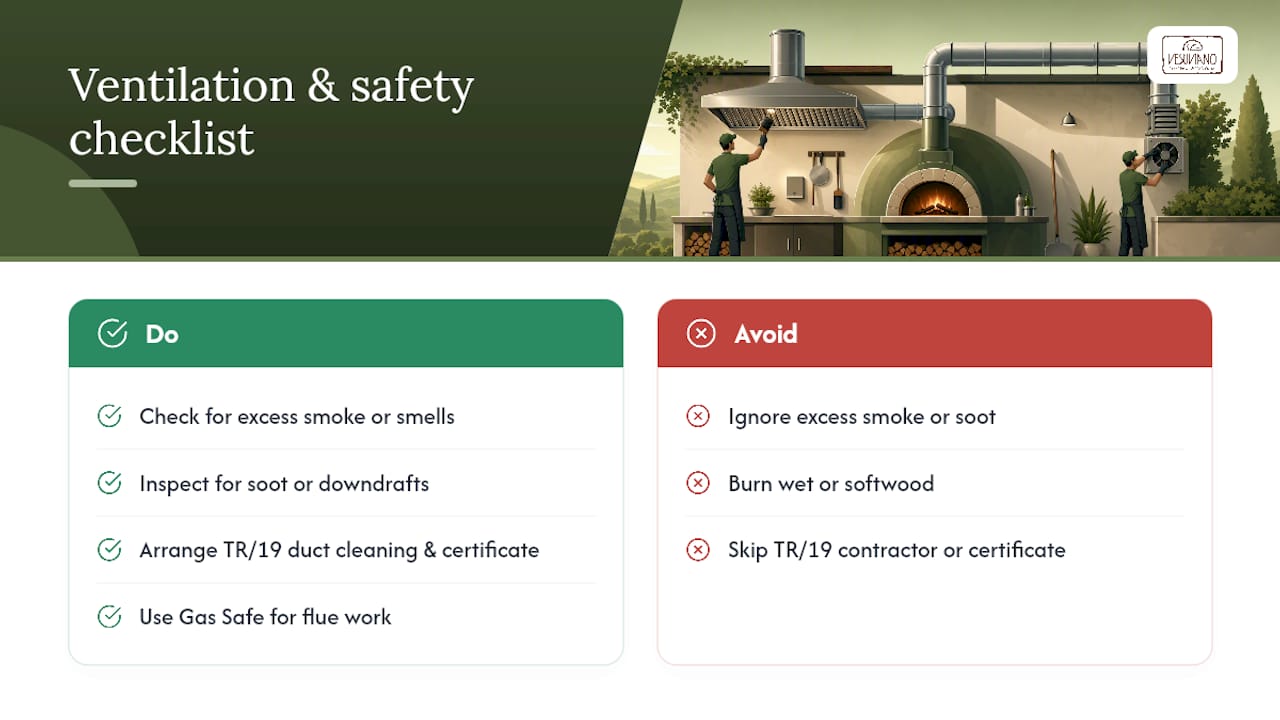
- Hood filters: clean or replace every 2–4 weeks depending on volume; grease-saturated filters restrict airflow and create a fire hazard
- Duct interior: professional duct cleaning every 6–12 months, carried out by a contractor certified to TR/19 (the BESA standard for ventilation hygiene in the UK)
- Flue and chimney (wood-fired): sweep every 6 months minimum; creosote build-up is combustible and can cause chimney fires
- Fan operation: check extraction fan runs at correct speed and without vibration at the start of each service
- Combustible clearances: confirm no combustible materials are stored within the clearance distances specified by the oven manufacturer and BS 6173 (installation of gas-fired catering appliances)
Signs of a ventilation problem
Excess smoke spilling into the kitchen, soot deposits on surfaces near the flue outlet, downdrafts that push smoke back into the room, and a persistent smell of combustion products during service all indicate a ventilation fault. Any of these warrants an immediate check before the next service.
Grease accumulation in extraction ductwork is one of the most significant fire risks in commercial kitchens. The BESA TR/19 standard sets out inspection and cleaning frequencies for UK operators, and compliance is increasingly expected by insurers and environmental health officers. A duct cleaning certificate from a TR/19-accredited contractor is the clearest evidence that this risk is being managed.
For wood-fired ovens, creosote management is a specific discipline. Burning only dry, seasoned hardwood (moisture content below 20%) produces far less creosote than wet or softwood. A calibrated moisture meter costs under £30 and pays for itself quickly by reducing flue cleaning frequency and fire risk.
Regulatory note: gas flue work must be carried out by a Gas Safe registered engineer. Extraction duct cleaning in commercial premises should be performed by a contractor working to TR/19. Local authority environmental health officers may request evidence of both during routine inspections.
A maintenance schedule and log template you can use today
A written schedule removes ambiguity about who does what and when. It also creates the audit trail that insurers, environmental health officers, and oven manufacturers may ask for.
| Frequency | Task | Responsible |
|---|---|---|
| Daily | Hearth brush and ash/debris removal | Kitchen staff |
| Daily | Crumb tray empty and wipe (gas/electric) | Kitchen staff |
| Daily | Door seal visual check and exterior wipe | Kitchen staff |
| Weekly | Full cool-state deck scrape and interior wipe | Senior kitchen staff |
| Weekly | Hood and vent visual check; grease filter wipe | Senior kitchen staff |
| Weekly | Door hinge and mechanism lubrication | Senior kitchen staff |
| Monthly | Infrared temperature map of deck | Manager or head chef |
| Monthly | Burner port inspection and clean (gas isolated) | Manager or qualified staff |
| Every 6–8 months | Lift stone, vacuum beneath, inspect insulation | Qualified technician |
| Every 6 months | Flue and exhaust clean | HVAC/TR/19 contractor |
| Annual | Full professional service (Gas Safe for gas) | Qualified engineer |
Maintenance log fields
Your log should capture, at minimum:
- Date and time of task
- Task performed and oven identifier
- Operator name
- Observations (condition, any anomalies noted)
- Actions taken (parts replaced, adjustments made)
- Next scheduled review date
- Service reference number (for professional visits)
Digital logs in a shared spreadsheet (Google Sheets, Microsoft Excel) or a dedicated kitchen management platform make it easy to share records with engineers and inspectors. Paper logs work equally well provided they are stored securely and retained for at least three years. Preventive maintenance records support warranty claims, insurance submissions, and demonstrate due diligence to environmental health authorities.
A simple CSV template with the columns above can be copied into any spreadsheet system in under five minutes. The discipline of filling it in consistently is what gives it value.
Manufacturer guidance from Vesuviano Forni
Vesuviano Forni’s handcrafted Neapolitan ovens are built using traditional Vesuvian techniques and materials that behave differently from mass-produced commercial ovens. That difference has direct implications for how you care for them.
Preserving the stone patina
The interior hearth and dome of a Neapolitan wood-fired oven develop a natural patina over time — a layer of carbonised oils and mineral deposits from repeated firing. This patina is not contamination. It contributes to heat distribution, moisture management, and the characteristic flavour profile of Neapolitan pizza. Stripping it with caustic cleaners or aggressive scrubbing degrades cooking performance and can take months of regular firing to restore.
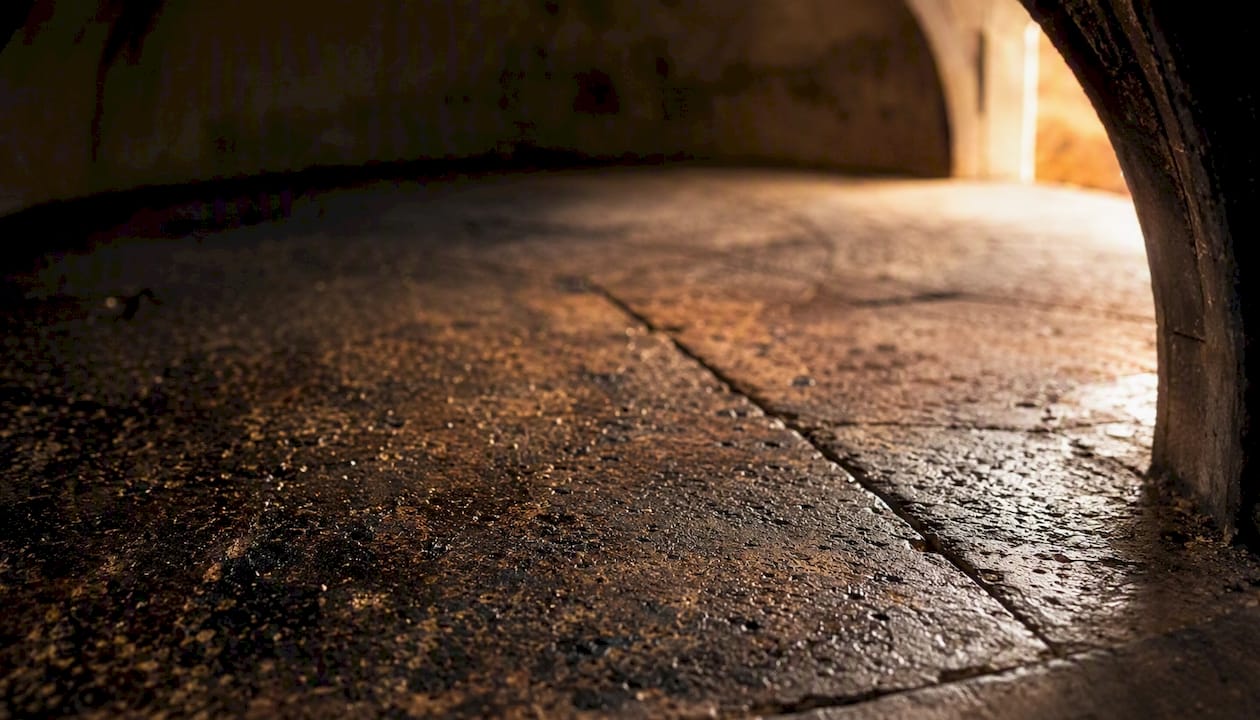
Vesuviano’s guidance aligns with broader industry advice on patina preservation: clean food debris, manage ash, but leave the stone surface itself alone beyond dry brushing. The oven’s cooking surface improves with use, not despite it.
Temperature management and maintenance
Correct temperature management is inseparable from good maintenance. Firing an oven too aggressively from cold stresses the refractory dome and can cause micro-cracking over time. Vesuviano’s guidance on commercial oven temperatures recommends a gradual warm-up protocol — particularly after the oven has been cold for an extended period or following any maintenance work that involved opening the dome or replacing components.
After-sales support from Vesuviano Forni
Vesuviano Forni provides a complete after-sales service covering installation, on-site construction, calibration, and spare parts supply. For operators running commercial wood-fired ovens, this means access to manufacturer-matched components and technical guidance from the artisans who built the oven. The VesuvioBuono low-emission models have specific flue and combustion characteristics that benefit from manufacturer-guided servicing rather than generic HVAC contractor visits.
Pro Tip: After any extended shutdown or off-season storage, fire the oven gradually over two or three sessions before returning it to full commercial use. This re-conditions the refractory and reactivates the patina layer without thermal shock.
- Use only dry, seasoned hardwood with moisture content below 20% in wood-fired models
- Avoid metal tools directly on the hearth stone; use wooden or composite peels
- Check the dome inspection port (where fitted) every six months for hairline cracks
- Contact Vesuviano’s after-sales team for spare parts to maintain warranty compliance
The maintenance mistakes operators keep making
The same errors come up repeatedly when operators contact us about performance problems or premature wear. They are almost always avoidable.
The most damaging is over-cleaning the stone. Operators who scrub the hearth with caustic oven cleaners after every service are not being thorough — they are destroying the cooking surface. The patina that builds up on a well-used Neapolitan oven is a functional asset. Treat it accordingly: brush away debris, leave the surface alone.
The second is deferring flue work. A flue sweep feels like an optional extra until the day a creosote fire closes your kitchen for a week. In a busy wood-fired operation, six months is the maximum interval between sweeps. Many operators stretch this to twelve or eighteen months and pay for it eventually.
The third is DIY gas adjustment. Operators who notice a yellow flame or inconsistent ignition and decide to adjust the gas valve themselves are taking a risk that no amount of time-saving justifies. A Gas Safe engineer costs less than the liability of a gas incident. The boundary between what staff can do and what requires a registered engineer is not bureaucratic caution — it is there because the consequences of getting it wrong are serious.
The corrective actions are simple: dry-brush the stone, book the flue sweep before you think you need it, and call a Gas Safe engineer the moment a gas fault appears.
Vesuviano Forni after-sales and authorised servicing
A Neapolitan oven built to last 15–20 years deserves maintenance support from people who understand how it was built. Vesuviano Forni offers authorised after-sales services covering installation, calibration, spare parts supply, and technical consultancy for operators across the UK and internationally.
Using Vesuviano-authorised engineers and OEM spare parts keeps your oven under warranty and gives you access to technical guidance specific to your model, whether that is a RealBosco wood-fired oven, a Sebastian gas model, or a VesuvioBuono low-emission system. Generic service contractors may not be familiar with the specific refractory compositions or dome geometries that define Neapolitan oven performance.
To request a service visit, spare parts, or a post-installation calibration check, contact Vesuviano Forni directly through the product and services pages. The team manages every stage from initial enquiry through to on-site support, with clear documentation provided after each visit for your maintenance records.
Sources
- Breakdown Ahead? Hot Tips for Taking Care of Deck and Conveyor Ovens - PMQ Pizza
- Pizza Oven Maintenance Guide: Complete Cleaning & Troubleshooting Tips – Crustify Pizza Ovens
- How to clean a pizza oven – mistakes I made so you don’t …
- Preventive Maintenance for Pizza Ovens | Safety & Profit Guide
- PIZZAMASTER CUSTOMER PREVENTITIVE MAINTENANCE CHECKLIST