Pizza oven weight: what to plan for transport and installation
Pizza oven weight: what to plan for transport and installation
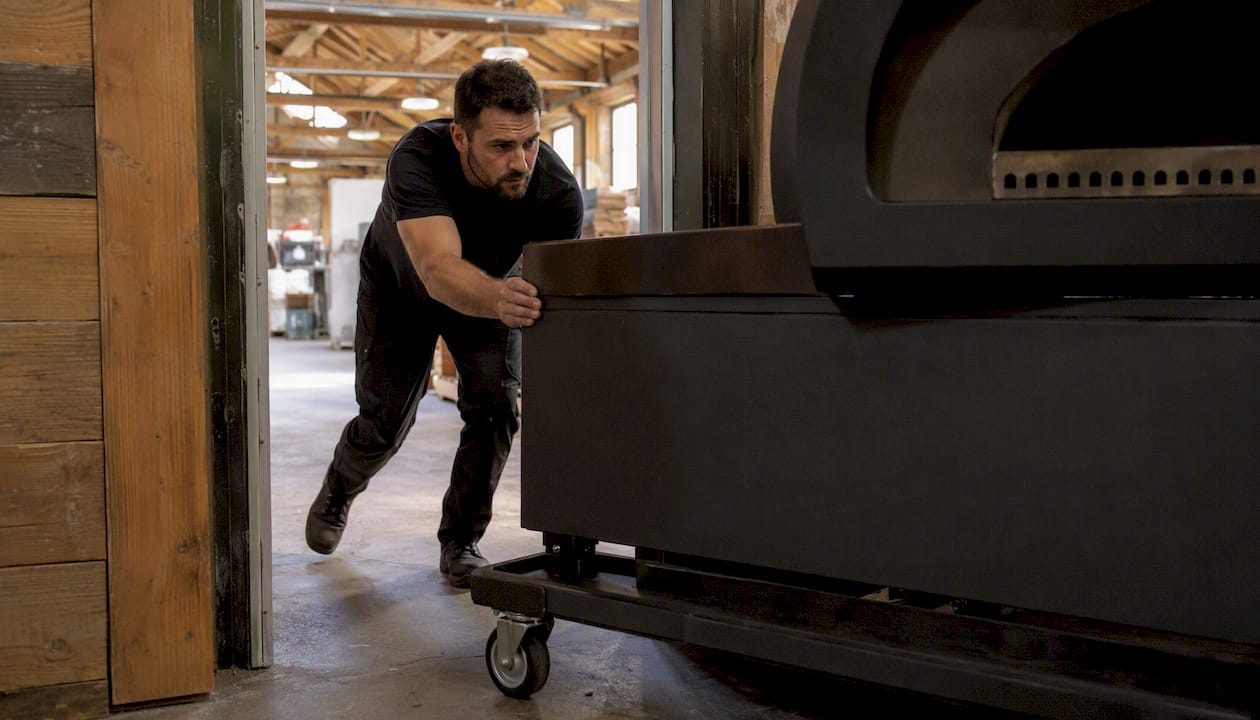
Pizza oven weight ranges from around 9 kg for a compact portable gas model to well over 2,000 kg for a large masonry dome. That single fact shapes every decision that follows: whether one person can carry it, what vehicle you need, whether your floor can bear the load, and whether you need a specialist contractor on site. According to Kitchendemy, wood-fired masonry ovens commonly reach 450–2,300 kg, commercial gas units 225–900 kg, and electric ovens roughly 45–225 kg. At the lighter end, the Ooni Koda 12 weighs just 9.25 kg, while editorial roundups from The Independent show most consumer outdoor models sitting in the 10–30 kg bracket. Here is a quick orientation before you go further:
- Portable tabletop/countertop (gas or electric, consumer): 9–30 kg. One or two people, no mechanical handling required.
- Mid-range outdoor multi-fuel or wood-fired portable: 30–80 kg. Two people minimum; a sack trolley is advisable.
- Commercial countertop electric or gas deck ovens: 45–225 kg. Mechanical handling likely; check floor loading.
- Commercial masonry or site-built wood-fired ovens: 450–2,300+ kg. Professional installation, structural floor survey, and crane or hoist access are standard requirements.
The UK’s Health and Safety Executive (HSE) sets a guideline upper limit of 25 kg for a single-person manual lift under ideal conditions. Anything above that threshold warrants a two-person lift or mechanical assistance, and anything above roughly 100 kg demands proper lifting equipment and a risk assessment.
Key takeaways
Pizza oven weight ranges from under 10 kg for a compact portable model to over 2,300 kg for a large site-built masonry dome, and the installed weight, not the published net figure, is the number that determines your vehicle, your floor specification, and your installation plan.
| Point | Details |
|---|---|
| Weight ranges by type | Portable gas models start at ~9 kg; commercial masonry domes reach 450–2,300+ kg. |
| Net vs installed weight | Published net weight excludes stand, flue, and base; always request installed weight for floor-loading calculations. |
| Lifting thresholds | HSE guidance sets 25 kg as the single-person limit; above 100 kg, mechanical handling is required. |
| Gross shipping weight | Gross weight can be 15–30% higher than net weight; confirm this figure before booking transport. |
| Vesuviano Forni | Offers RealBosco, Sebastian, and VesuvioBuono commercial ovens with full UK logistics, installation, and technical consultancy. |
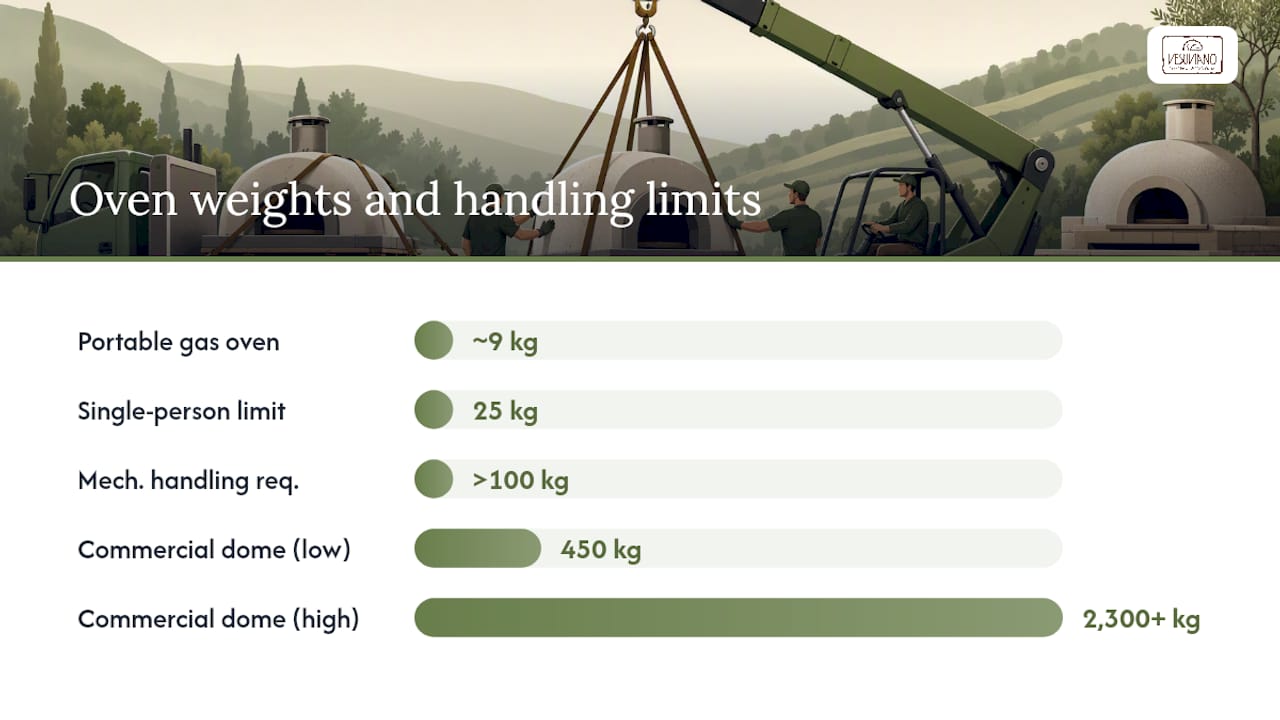
Table of Contents
- How much does a pizza oven weigh? Weight and footprint by type
- Why do ovens of the same size weigh so differently?
- How to read manufacturer weight specs and measure for yourself
- Safe lifting and moving: practical guidance for every weight band
- Commercial and site-built ovens: weights, floor loading, and professional installation
- How oven weight should shape your buying decision
- Weight planning: what UK buyers consistently underestimate
- Vesuviano Forni: professional ovens with full logistics support
- Sources
How much does a pizza oven weigh? Weight and footprint by type
The table below covers the main oven categories, giving you the numbers you need to plan a purchase, a delivery route, or a building project.
Tested reviews from The Spruce Eats confirm that consumer models with measured weights around 14–15 kg are common in the mid-range portable bracket, which aligns with the lower end of the multi-fuel category above.
A few edge cases worth noting:
- Some compact electric countertop models marketed as “light commercial” can still exceed 60 kg once the stand is included, even though the unit itself is listed at 35–40 kg.
- Very large masonry dome specification sheets, such as those published by commercial dome manufacturers, list net weights from around 1,200 kg up to 2,700 kg for the largest models, before packaging or base structure.
- A rotating deck mechanism, as found in commercial rotating ovens, adds meaningful mass to the installed weight and shifts the centre of gravity, which affects both transport and installation planning.
Why do ovens of the same size weigh so differently?
The answer lies almost entirely in the materials and construction method. Understanding this helps you compare specifications honestly rather than assuming a similar footprint means a similar weight.
The primary contributors to oven mass are:
- Refractory brick and cooking stone: Dense, heat-retaining materials used in the dome, floor, and walls of traditional Neapolitan ovens. A single refractory brick can weigh 3–5 kg; a full dome uses dozens of them.
- Steel shell and cladding: Stainless steel outer shells add structural rigidity and weather resistance. Thicker gauge steel, used in professional-grade units, adds considerably more mass than the thin sheet metal found in consumer models.
- Insulation type and depth: Ceramic fibre blanket is lighter than vermiculite or perlite concrete. Rockwool panels sit between the two. A well-insulated commercial oven may carry 20–40 kg of insulation material alone.
- Cooking stone thickness: A 4 cm refractory stone floor retains heat far better than a 1.5 cm cordierite stone, but it also adds significant weight per square centimetre of cooking surface.
- Integrated stand or base: Many manufacturers publish the unit weight without the stand. A fabricated steel stand for a commercial oven can add 30–80 kg to the installed weight.
- Flue and chimney components: A cast-iron or steel flue assembly, particularly one with a spark arrestor and rain cap, adds 10–25 kg depending on length and material.
Pro Tip: Dome-shaped ovens distribute mass unevenly. The base and floor carry the greatest concentration of weight, while the dome itself is comparatively lighter. This means the oven’s centre of gravity sits low, which is good for stability but makes tilting or angling during installation genuinely hazardous. Always lift from the base, never from the dome.
The same external footprint can produce very different installed weights depending on whether the shell is thin-gauge steel over ceramic fibre, or hand-laid refractory brick over a poured concrete base. For a detailed breakdown of how wood-fired pizza oven dimensions relate to construction mass, the guidance is worth reading before you finalise a specification.
How to read manufacturer weight specs and measure for yourself
Manufacturer weight figures are not always what they appear. Misreading them is one of the most common planning mistakes, and it can mean a vehicle that is under-rated for the load or a doorway that turns out to be 5 cm too narrow.
What manufacturers typically publish:
- Net weight: The unit alone, without packaging, stand, flue, or accessories. This is the figure most commonly shown on product pages.
- Gross weight: The unit plus all packaging, pallets, and protective materials. For commercial ovens, gross weight can be 15–30% higher than net weight. Commercial igloo oven specification sheets consistently show gross shipping weights appreciably higher than the published net figures.
- Installed weight: Rarely published, but the figure that actually matters for floor-loading calculations. It includes the unit, stand, base slab, flue, and any integrated surround.
Step-by-step: how to verify or estimate weight when data is missing
- Check the product page and spec sheet separately. The spec sheet often includes gross weight and packaging dimensions that the product page omits.
- Contact the manufacturer directly and ask specifically for net weight, gross shipping weight, and whether the stand and flue are included in either figure.
- For small ovens (under 50 kg): Place a bathroom scale on a firm, level surface, lift the oven onto it carefully with a second person, and record the reading. Cross-reference against the published figure.
- For larger ovens: Use a pallet scale or load cell, available from tool-hire companies across the UK. Position the oven on the scale before removing it from its pallet.
- For masonry or site-built ovens: Estimate installed weight by calculating the approximate volume of each material (refractory brick, concrete, insulation) and multiplying by standard material densities. Refractory brick runs approximately 1,900–2,100 kg/m³; dense concrete approximately 2,400 kg/m³.
- Record the following before booking transport: net weight, gross shipping weight, external footprint (L×W×H), doorway and access route dimensions, declared centre of mass, and available lifting points.
What to record for logistics planning:
- External dimensions including any protruding handles, flue collars, or feet
- Doorway height, width, and any steps or ramps on the delivery route
- Floor type and load-bearing capacity at the installation point
- Whether a tail lift, pallet truck, or crane is needed at the delivery address
Safe lifting and moving: practical guidance for every weight band
Matching the lifting method to the oven’s actual weight is not optional. The HSE’s manual handling guidance makes clear that loads above 25 kg for a single person, or above roughly 50 kg for a two-person team, require a formal risk assessment and mechanical assistance in most workplace contexts.
By weight band:
- Under 25 kg: Single-person carry is generally acceptable on a level surface. Use a carrying strap or handle grip to maintain posture.
- 25–50 kg: Two-person lift. Use a sack trolley or appliance dolly for any distance beyond a few metres.
- 50–150 kg: Mechanical handling required. A pallet truck works on flat surfaces; an appliance trolley with straps handles stairs and ramps. A two-person team with proper PPE (gloves, steel-toecap footwear) is the minimum crew.
- 150–500 kg: Pallet truck or forklift for loading and unloading. A four-wheel furniture dolly and moving straps for short repositioning on site. Tail-lift van or flatbed lorry for transport.
- Above 500 kg: Specialist heavy-move contractors, engine hoist, or crane. The Patio and Pizza blog recommends renting an engine hoist for heavy brick ovens and stresses confirming the hoist’s rated capacity before any lift. For very large commercial installations, a telehandler or crane is the standard approach.
Vehicle guidance by weight class:
- Up to 150 kg: standard transit-size van (3.5-tonne GVW), secured with ratchet straps
- 150–500 kg: large panel van with tail lift, or a Luton box van with a tail lift rated to at least 500 kg
- Above 500 kg: flatbed lorry, curtainsider, or low-loader; pallet delivery service rated for the gross shipping weight
Pro Tip: Always check floor-loading capacity before positioning a heavy oven. A commercial masonry oven at 600 kg concentrated on a 0.5 m² base exerts roughly 12 kN/m², which exceeds the structural capacity of many standard domestic or light-commercial concrete floors. A structural engineer’s sign-off costs far less than repairing a failed floor.
For readers coordinating a large-item delivery, specialist large-item movers who handle heavy freight can manage the logistics from collection to placement, which is worth considering for any oven above 300 kg.
Safety checklist before any heavy oven move:
- Confirm the oven’s gross weight and centre of mass with the manufacturer
- Measure every doorway, corridor, and stair on the delivery route
- Check floor-loading ratings at the delivery point and the final installation position
- Verify the rated capacity of all lifting equipment before use
- Brief all crew on the lift plan; assign a single person to direct the move
Commercial and site-built ovens: weights, floor loading, and professional installation
For hospitality buyers, the weight question becomes a structural and logistical project in its own right. A prefabricated commercial masonry oven typically arrives with a net dome weight of 450–900 kg, but the installed mass, once the base, flue, surround, and any integrated counter are included, can reach 1,200–1,800 kg or more. Site-built ovens, constructed in layers on site, can exceed 2,300 kg for large-format domes, as commercial dome specification sheets confirm.
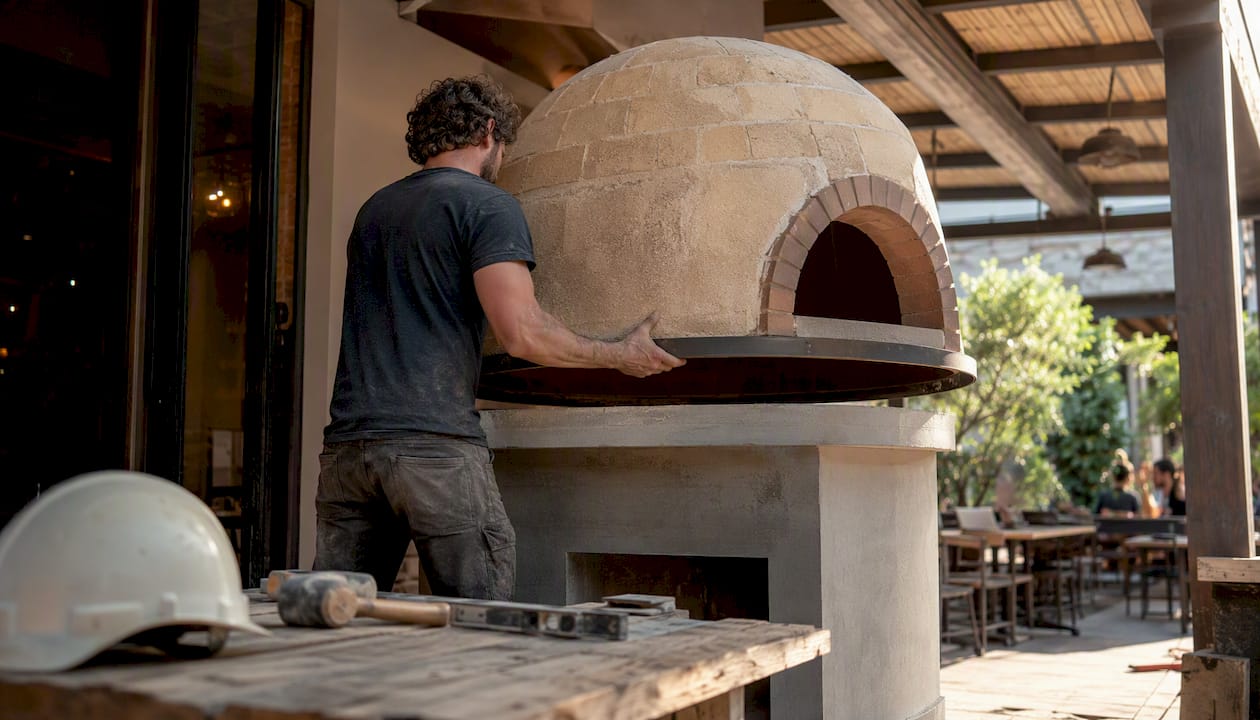
Staged delivery is the norm for large commercial installations. The dome, base, and flue components typically arrive on separate pallets, each requiring a pallet truck or forklift at the delivery point. Access routes need to accommodate a pallet at minimum, and many restaurant or hotel kitchen installations require temporary scaffold or a telehandler to position the dome.
Client preparation checklist for a commercial oven installation:
- Commission a structural floor survey and confirm load-bearing capacity at the installation point
- Measure all access routes: entrance doors, corridors, kitchen doorways, and any level changes
- Confirm crane or telehandler access if the oven is above 500 kg or if the installation point is above ground floor
- Arrange a clear, level unloading area close to the building entrance
- Confirm ventilation and flue route dimensions before the oven arrives
- Identify the connection points for gas, electricity, or water as applicable
Vesuviano Forni’s handcrafted Neapolitan ovens span all three product families: the RealBosco (traditional mosaic construction, available in wood-fired, gas, electric, and rotating versions), the Sebastian (contemporary metal-slat finish, wood-fired, gas, and electric), and the VesuvioBuono (low-emission wood-fired or combined gas/wood). Each family covers a range of installed weights, and the company provides technical consultancy, customs clearance, international logistics, and on-site assembly as part of its end-to-end service. For a UK restaurant or hotel project, that means a single point of contact from the initial site survey through to post-installation support, including planning for crane access and floor-loading documentation.
For bespoke builds, the custom-built outdoor pizza oven guide covers how site-specific weight and access constraints shape the design from the outset.
How oven weight should shape your buying decision
Weight is not just a logistics number. It is a proxy for heat retention, durability, and how permanently you are committing to a location.
Lightweight portable ovens (under 30 kg):
- Genuinely portable; one or two people can move them without equipment
- Reach cooking temperature quickly (15–20 minutes for most gas models)
- Lower thermal mass means temperature fluctuates more during a busy service
- Suited to mobile caterers, pop-up events, and domestic outdoor use
- Lower upfront cost and no installation requirements
Heavy masonry or commercial units (above 200 kg):
- Exceptional heat retention; the thermal mass stabilises cooking temperature across a long service
- Authentic Neapolitan cooking performance, particularly for wood-fired models
- Permanent or semi-permanent installation; moving them is a project, not a task
- Higher upfront investment, but longevity measured in decades with proper maintenance
- Suited to restaurants, pizzerias, hotels, and food halls with a fixed kitchen
Three quick decision checkpoints:
- How often will you move it? If the answer is regularly, stay under 30 kg. If never, thermal mass and durability should drive the choice.
- What does your site allow? Floor loading, access routes, and planning permissions all constrain the maximum weight you can realistically install.
- What cooking volume do you need? Higher throughput demands greater thermal mass, which means greater weight. A busy pizzeria turning 100 covers a night needs a fundamentally different oven from a weekend caterer doing 30.
For outdoor settings, the contemporary pizza oven guide for UK outdoor use covers how to match oven weight and footprint to a terrace or garden kitchen layout.
Weight planning: what UK buyers consistently underestimate
The net weight on a product page is almost never the number that matters for logistics. The installed weight, which includes the base, stand, flue, and any integrated surround, is the figure a structural engineer needs. The gross shipping weight is the figure a haulier needs. These are three different numbers, and conflating them causes real problems on delivery day.
For UK hospitality clients specifically, the combination of older building stock, narrow doorways, and multi-storey kitchens makes access planning more demanding than in purpose-built commercial premises. A handcrafted Vesuviano Forni oven, built to professional specification in Naples and shipped to the UK, arrives with full technical documentation, and the team manages the logistics precisely because these details matter. When the installation is complex, that support is not a luxury.
Vesuviano Forni: professional ovens with full logistics support
When the weight of your oven is measured in hundreds of kilograms rather than tens, the quality of the logistics support matters as much as the quality of the oven itself. Vesuviano Forni’s three product families, RealBosco, Sebastian, and VesuvioBuono, cover the full range of commercial weight classes, from mid-weight prefabricated units to large site-built domes, and every order includes technical consultancy, international shipping, customs clearance, and on-site installation.
For UK restaurants, hotels, and food halls, Vesuviano Forni handles the complete journey from site survey and floor-loading assessment through to final commissioning. The team can advise on crane access, structural requirements, and flue routing before a single component leaves Naples. If you are planning a commercial wood-fired pizza oven installation or need a bespoke site-built solution, contact Vesuviano Forni for a technical consultation and a tailored logistics plan.
Sources
- How Much Does A Pizza Oven Weigh? The Ultimate Guide - Kitchendemy
- 14 best pizza ovens for indoor and outdoor cooking
- The 8 Best Pizza Ovens of 2026, Tested & Reviewed
- How Do You Move a Brick Pizza Oven to its Base? (Patio and Pizza blog)