How many pizzas per hour can your oven produce?
How many pizzas per hour can your oven produce?
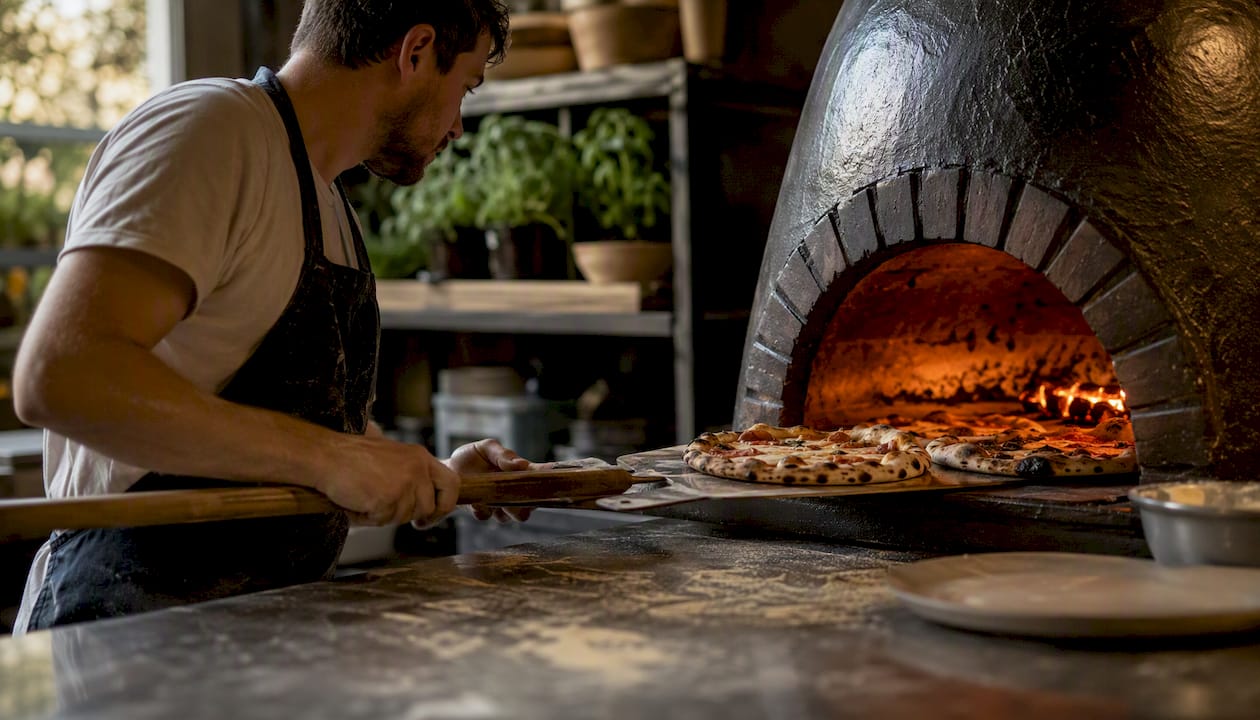
Most commercial pizza ovens realistically deliver a varied number of pizzas per hour depending on oven type, pizza size, and how well the operation is run. The calculation is straightforward: pizzas per hour = pizzas per load × (60 ÷ cycle time in minutes), where cycle time includes bake time, heat recovery, and handling. A practical industry guide notes that real-world output typically runs at 60–80% of theoretical maximums, so conservative planning is always the wiser approach.
Here are realistic ranges by oven family:
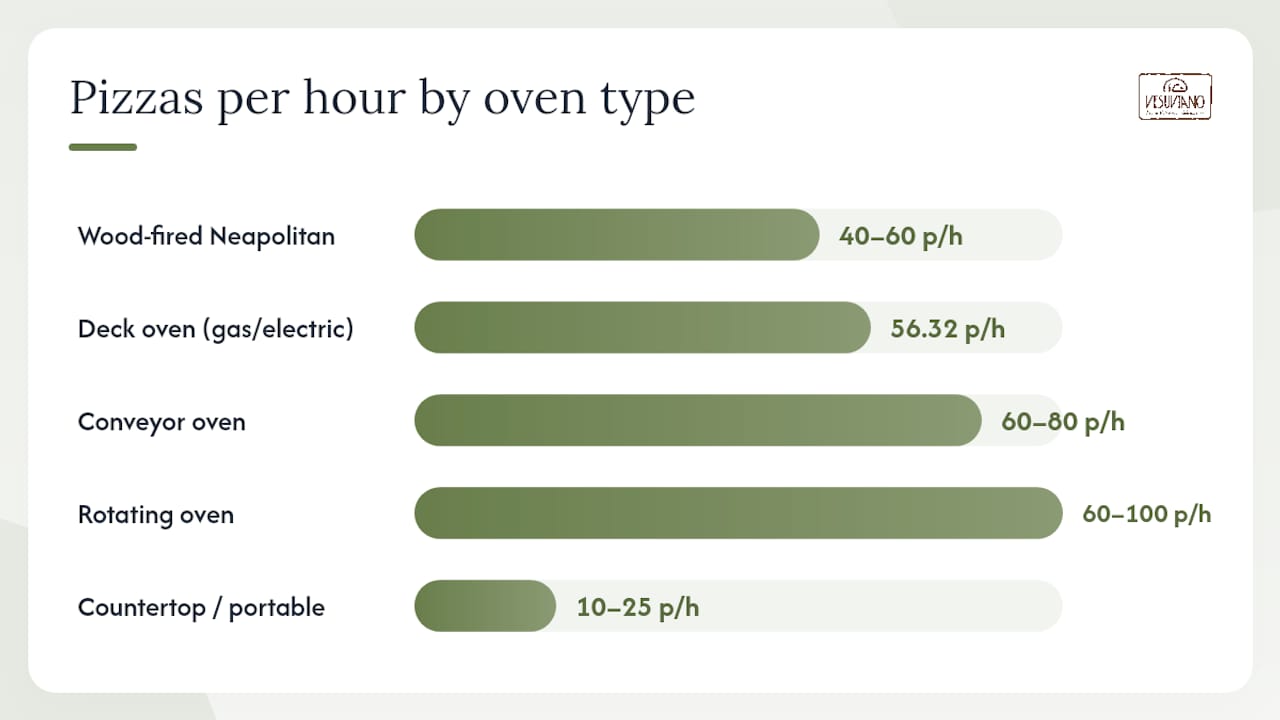
- Wood-fired Neapolitan hearth: 25–60 pizzas per hour (90-second bake, but recovery and loading limit continuous output)
- Gas deck oven: 30–70 pizzas per hour per deck
- Electric deck oven: 30–60 pizzas per hour per deck
- Conveyor oven: 60–120+ pizzas per hour (size and belt speed dependent)
- Commercial rotating oven: 40–100 pizzas per hour
- Countertop/portable units (e.g. Ooni, Gozney): 10–25 pizzas per hour under sustained service
A heavy-load deck oven test by SCE Design and Engineering Services measured a cook time of 8 minutes 30 seconds and a production rate of approximately 56.32 pizzas per hour per deck under controlled conditions, with a triple-deck configuration reaching close to 169 pizzas per hour. That figure represents a well-managed upper bound; most kitchens will land below it.
Key takeaways
| Point | Details |
|---|---|
| Realistic output ranges | Wood-fired: 25–60/hour; deck ovens: 30–70/deck; conveyor: 60–120+; rotating: 40–100. |
| The core formula | Pizzas per hour = pizzas per load × (60 ÷ cycle time in minutes), with a 0.65–0.8 real-world multiplier applied. |
| Biggest throughput lever | Staggered loading and pre-staged batches reduce dead time more than any single equipment upgrade. |
| Operating cost interaction | Continuous high-load operation is more energy-efficient per pizza than cycling the oven on and off between orders. |
| Vesuviano Forni | Offers handcrafted Neapolitan ovens across wood-fired, rotating, and electric families, with throughput consultancy and full UK installation support. |
Table of Contents
- How do you calculate pizzas per hour for your oven?
- What throughput can you expect from each oven type?
- What factors actually change your pizzas-per-hour output?
- How do rotation and staging strategies raise hourly output?
- How do you convert your demand into oven and staff requirements?
- How do fuel and operating costs interact with throughput decisions?
- What throughput does Vesuviano Forni expect from its oven families?
- Common bottlenecks that stop you reaching rated throughput
- Vesuviano Forni: matching your output target to the right oven
- Sources
How do you calculate pizzas per hour for your oven?
The formula is simple, but the inputs require honest measurement. Here is a step-by-step method you can apply to any oven set-up.
Define your terms first:
- Pizzas per load: the number of pizzas your oven holds simultaneously at full capacity
- Bake time: the time from loading to removal for a single batch
- Heat recovery time: the time the oven needs to return to its working setpoint after a load is removed and the door reopened
- Handling time: the combined time for stretching, topping, loading, and unloading each batch
The calculation:
- Measure your bake time under real service conditions (not a cold-start test).
- Measure heat recovery: load a full batch, remove it, and time how long the floor or deck takes to return to setpoint.
- Add handling time per batch (typically 60–120 seconds for a skilled operator).
- Calculate cycle time: bake time + recovery time + handling time.
- Divide 60 by cycle time (in minutes) to get loads per hour.
- Multiply loads per hour by pizzas per load.
Worked examples:
- 12" Neapolitan, wood-fired hearth: 3 pizzas per load, 90-second bake, 60-second recovery, 60-second handling = cycle time 3.5 minutes → 17.1 loads per hour → 51 pizzas per hour (theoretical). Apply a 0.75 real-world multiplier: ~38 pizzas per hour.
- 14" pan pizza, gas deck: 4 pizzas per load, 8-minute bake, 2-minute recovery, 1-minute handling = cycle time 11 minutes → 5.45 loads per hour → 22 pizzas per hour per deck.
- Conveyor line: 6 pizzas in transit at any time, 6-minute belt time, continuous flow = approximately 60 pizzas per hour at standard 12" sizing.
Pro Tip: Apply a planning multiplier of 0.65–0.8 to any theoretical figure from a vendor spec sheet. An interactive pizzas-per-hour calculator from Ovention Ovens lets you test how oven model, pizza size, and cook mode change the theoretical yield before you commit to a purchase.
Audit checklist for your kitchen:
- Time three consecutive full-load bake cycles during a busy service.
- Record recovery time between each cycle.
- Note operator handling time separately from bake time.
- Calculate average cycle time across all three runs.
- Apply the formula and compare to your target output.
- Identify the longest step: that is your bottleneck.
What throughput can you expect from each oven type?
Throughput varies significantly across oven families, and the gap between theoretical and real-world output widens as service pressure increases.
Wood-fired Neapolitan hearth The soul of Neapolitan pizza production, but also the most operator-dependent format. At 450–500°C, a skilled pizzaiolo can bake a 12" Neapolitan in 60–90 seconds. With 3–4 pizzas per load and a well-managed fire, 40–60 pizzas per hour is achievable. Forum reports from experienced operators describe peak outputs approaching 100 pizzas per hour from gas-assisted wood ovens under ideal conditions, though this demands a dedicated oven operator and continuous fire management. Recovery losses from door opening are the primary constraint.
Gas deck oven Consistent temperature control makes gas decks reliable workhorses. A single deck typically holds 4–6 pizzas at 12" and bakes in 6–10 minutes. The Revent deck oven test data recorded 56.32 pizzas per hour per deck under heavy-load conditions, a figure most operators should treat as an upper bound rather than a planning target.
Electric deck oven Electric decks offer precise, programmable temperature control and lower emissions, making them well-suited to urban kitchens. Output per deck is broadly comparable to gas, though preheat time is longer and recovery after heavy loading can be slightly slower depending on element rating. For a detailed comparison of commercial electric pizza ovens, the capacity and energy trade-offs are worth reviewing before specifying.
Conveyor oven The highest-volume format for standardised products. Belt speed and lane width determine output; a single-lane conveyor running 12" pizzas on a 6-minute programme typically delivers 60–80 pizzas per hour. Dual-lane models can double that. Quality trade-offs are real: the radiant-plus-impingement cooking profile suits American-style and thin-crust products better than Neapolitan.
Commercial rotating oven Rotating ovens combine the even heat distribution of a deck with continuous loading capability. For operators who need compact footprint and consistent output, a commercial rotating pizza oven can deliver 60–100 pizzas per hour depending on chamber size and rotation speed. The rotating platform eliminates the need to turn individual pizzas, reducing operator intervention and recovery losses.
Countertop/portable units Ooni and Gozney units are designed for domestic and small-event use. Some countertop electric models advertise 12" pizzas in approximately 2 minutes under optimal stone-temperature conditions, but sustained throughput is limited by stone recovery between bakes. Realistic service output sits at 10–25 pizzas per hour, making these unsuitable for any operation with a peak demand above 30 covers.
| Oven type | Capacity per load | Cook time | Realistic pizzas/hour |
|---|---|---|---|
| Wood-fired Neapolitan | 3–5 | 60–90 sec | 30–60 |
| Gas deck (per deck) | 4–6 | 6–10 min | 30–56 |
| Electric deck (per deck) | 4–6 | 6–10 min | 25–50 |
| Conveyor (single lane) | 5–8 in transit | 5–8 min | 60–100 |
| Commercial rotating | 4–8 | 3–6 min | 60–100 |
| Countertop/portable | 1–2 | 2–5 min | 10–25 |
What factors actually change your pizzas-per-hour output?
Throughput is not fixed by the oven alone. Several operational and physical variables move the needle, and most of them are within your control.
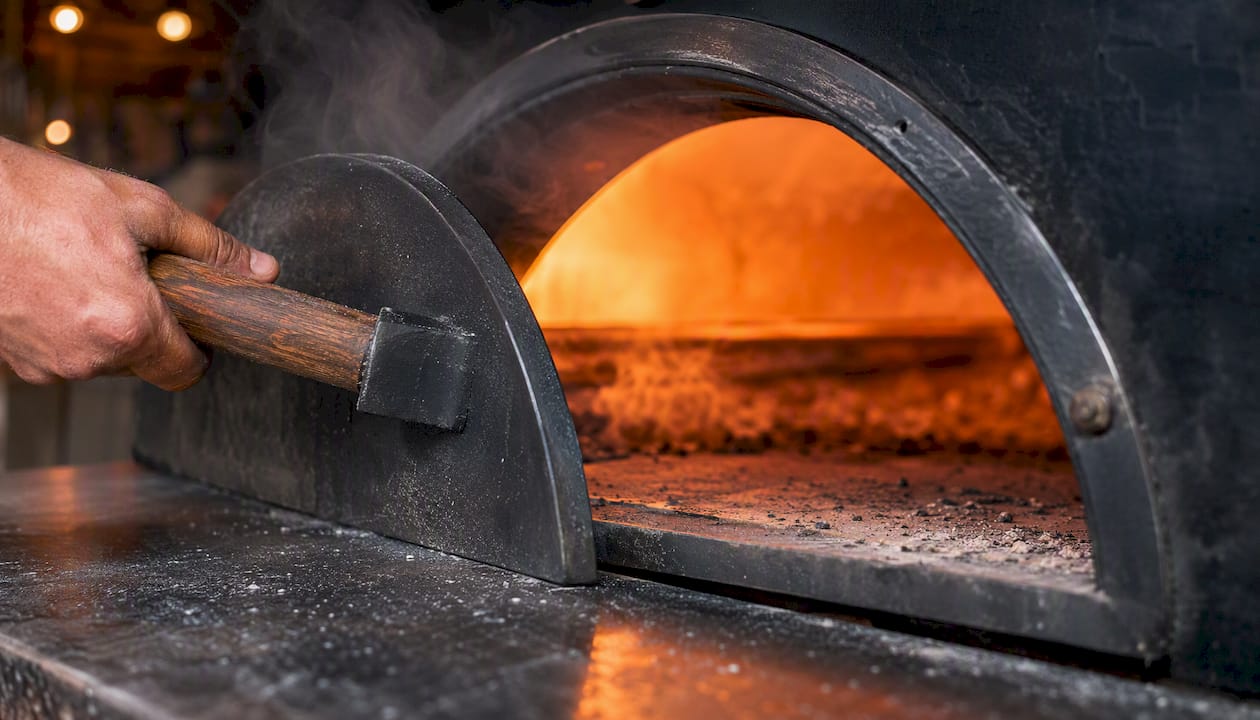
Cook time and heat recovery These two factors together account for the majority of the gap between rated and actual output. Thermal mass is the key variable: a thick refractory floor retains heat through repeated door openings far better than a thin steel deck. Every time you open the oven door, you lose radiant energy from the chamber. In a wood-fired oven, this can drop the floor temperature by 20–30°C per full load removed, requiring 60–90 seconds of recovery before the next batch achieves the same bake quality. Reducing door-open time and pre-staging the next batch on the peel are the two fastest ways to cut recovery losses.
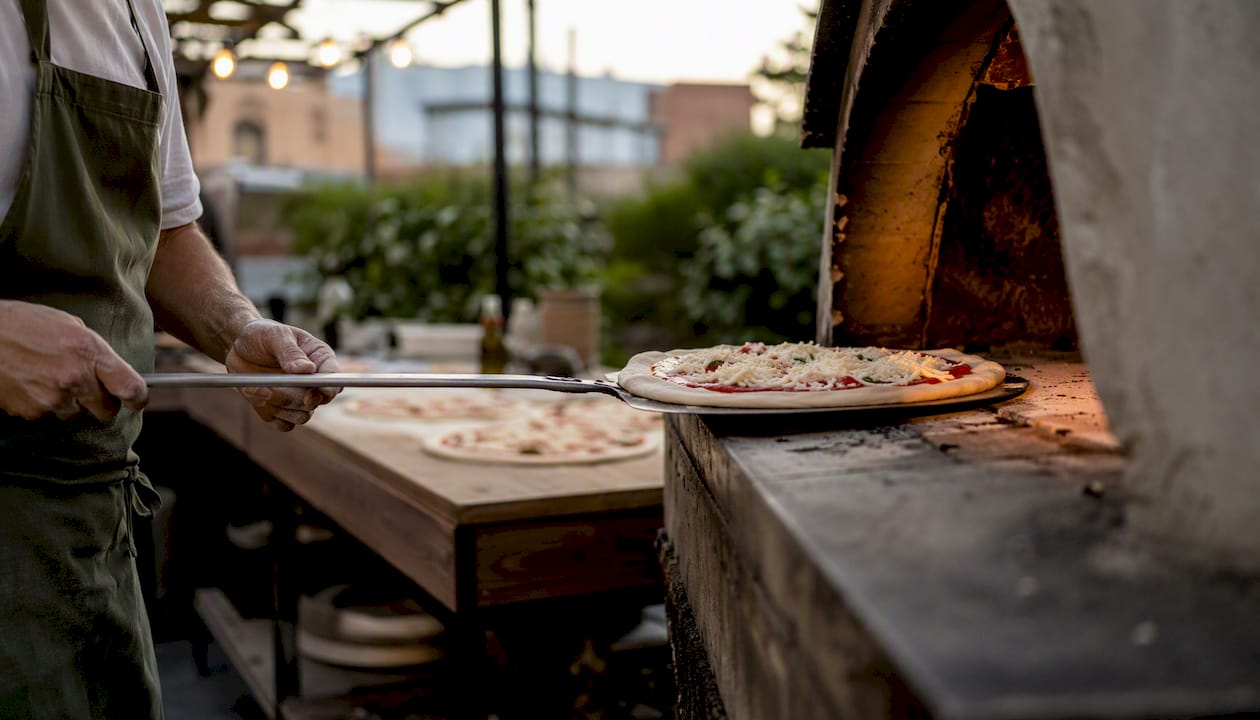
Pizza size and thickness A 12" Neapolitan and a 14" deep-pan are not interchangeable in throughput terms. Thicker bases absorb more heat from the deck and require longer bake times; larger diameters reduce the number of pizzas per load.
Operator workflow and skill A skilled pizzaiolo who pre-stages toppings, loads and unloads in a single fluid motion, and monitors the fire continuously will consistently outperform a less experienced operator on identical equipment.
Maintenance and cleaning A dirty oven floor conducts heat unevenly, extending bake time and increasing the risk of under-cooked bases. Carbon build-up on deck surfaces reduces emissivity. Blocked burner ports on gas ovens cause temperature inconsistency. These are not dramatic failures; they are slow, invisible throughput drains that compound over a service. Scheduling a weekly deep clean and a monthly burner inspection protects your rated output.
Pro Tip: Combining a high-throughput base cook (hot-air impingement or conveyor) with an infrared finishing stage can reduce total cooking time by around 50% and cut energy consumption by approximately 27%, according to experimental research on technology combinations. This hybrid approach suits high-volume operations where product consistency and speed are both priorities.
How do rotation and staging strategies raise hourly output?
The difference between 40 and 70 pizzas per hour on the same oven is almost always a workflow question, not an equipment question.
Common rotation patterns
- Staggered loading: Load 2–3 pizzas every 30–45 seconds rather than filling the oven in one go. This creates a rolling bake cycle where the first pizzas are ready as the last ones go in, eliminating the dead time of waiting for a full batch to finish simultaneously.
- Batch staging: Prepare all toppings for the next batch while the current one bakes. The loader never waits for the oven; the oven never waits for the loader.
- Conveyor pacing: On conveyor ovens, feed rate is the primary control. Operators should track the number of pizzas entering the belt per 10-minute window and adjust topping speed to match the belt’s capacity, not exceed it.
Role checklist for a high-throughput service
- Dough maker/shaper: stretches and tops; targets one pizza every 45–60 seconds at peak.
- Oven operator: loads, monitors, rotates (where needed), and unloads; manages fire or temperature controls.
- Finisher: slices, boxes, and dispatches; keeps the pass clear so the oven operator is never waiting.
For outputs below 40 pizzas per hour, a single skilled operator can manage all three roles. Between 40 and 70, a two-person team is the practical minimum. Above 70, a three-person team with clearly defined roles is standard. Operator forum discussions consistently highlight that starting the oven 60–90 minutes earlier than the first service ticket is one of the most effective heat-management tactics available, particularly for wood-fired hearths where thermal mass takes time to saturate.
Single-oven workflow template (target: 50 pizzas per hour)
- Oven at setpoint 60 minutes before service.
- First load in 10 minutes before doors open (staff meal or quality check).
- Staggered loading begins at service start: 3 pizzas every 90 seconds.
- Oven operator rotates each pizza at the 45-second mark.
- Finisher clears the pass every 2 minutes.
- Dough shaper maintains a 5-pizza buffer of topped, uncooked bases at all times.
How do you convert your demand into oven and staff requirements?
Start with your peak covers, not your average. A 60-seat restaurant turning tables twice in an evening might need 80 pizzas in a 90-minute window, which translates to a sustained requirement of approximately 53 pizzas per hour at peak.
| Peak demand (pizzas/hour) | Recommended oven capacity | Minimum staff (oven team) |
|---|---|---|
| Up to 30 | Single deck or wood-fired hearth | 1 operator |
| 30–60 | Double deck or commercial rotating | 2 operators |
| 60–100 | Triple deck, dual rotating, or conveyor | 3 operators |
| 100–120+ | Multi-conveyor or 4+ deck configuration | 4+ operators |
Sizing checklist:
- Calculate peak demand from your busiest historical service, not your average.
- Add 20–25% spare capacity to cover maintenance windows and demand spikes.
- Confirm extraction and ventilation capacity matches the oven’s BTU or kW rating.
- Check floor loading and door clearance for the oven footprint you are considering.
- For Italian commercial pizza oven options across different throughput bands, reviewing the full oven family range helps match capacity to kitchen constraints.
- For events and pop-ups, build in 30% additional spare capacity: demand is less predictable and recovery time between courses is compressed.
How do fuel and operating costs interact with throughput decisions?
Higher throughput means more energy consumed per hour, but not necessarily more energy consumed per pizza. A well-loaded oven running continuously is more efficient per unit than one cycling on and off between orders.
A peer-reviewed review of wood-fired, electric, and gas Neapolitan ovens reported typical energy price ranges of €0.30–0.38/kWh for electricity, €0.8–1.2/m³ for natural gas, and approximately €2.00–2.30/kg for LPG, with electric operating costs ranging from €2.10 to €4.10 per hour depending on contract. Firewood can be economical at low purchase prices, though sourcing consistency and storage space are practical constraints in UK urban settings. For a detailed breakdown of wood-fired oven costs in a UK context, including current firewood and gas pricing, the Vesuviano Forni guide covers the key figures.
Planning should account for long preheat times as part of the total duty-cycle cost, particularly for electric models where preheat can take 45–90 minutes.
Statistic: Combining infrared finishing with hot-air impingement can reduce cooking time by approximately 50% and cut energy consumption by around 27%, according to experimental research — a meaningful saving at high throughput volumes.
Efficiency tips:
- Batch your service windows to keep the oven at temperature continuously rather than cycling it down between sittings.
- Reduce unnecessary door openings during recovery periods.
- Consider a hybrid technology approach (impingement base cook plus infrared finish) for operations above 80 pizzas per hour where energy cost per pizza becomes a significant margin factor.
What throughput does Vesuviano Forni expect from its oven families?
Vesuviano Forni’s handcrafted Neapolitan ovens are built for professional service, and the throughput expectations below reflect real-world operation rather than laboratory ideals.
Installation checklist that affects throughput:
- Ventilation and extraction rated to the oven’s maximum BTU or kW output.
- Benching height and peel clearance (minimum 900mm working depth recommended).
- Door clearance for loading and unloading without obstruction.
- Gas supply pressure confirmed for gas models (natural gas or LPG specification).
- 3-phase power supply confirmed for high-wattage electric and rotating models.
- Logistics access for delivery and on-site assembly where the oven is built in place.
Common bottlenecks that stop you reaching rated throughput
Most operations that fall short of their target output share the same handful of problems.
Temperature drop after heavy loading. Opening the oven door repeatedly during a busy service is unavoidable, but each opening costs heat. Operators who load one pizza at a time rather than filling the oven to capacity are effectively halving their potential output. Filling the oven to its rated capacity per load and staggering the timing is more efficient than frequent single-pizza loading.
Dough bottleneck upstream. The oven is rarely the limiting factor in a poorly organised kitchen. If the dough shaper cannot keep pace with the oven’s capacity, the oven sits idle between loads. Mapping the full production line, from dough ball to dispatch, reveals where the true constraint sits.
Inconsistent stone or deck temperature. Operators who rely on visual cues rather than a calibrated thermometer often bake at temperatures 30–50°C below setpoint without realising it. A laser thermometer or embedded thermocouple pays for itself in consistent bake times and reduced waste. For guidance on commercial pizza oven temperatures and how setpoint affects recovery, the full temperature guide covers the practical detail.
Cleaning and maintenance deferred. Carbon build-up on the deck surface reduces heat transfer efficiency over time. Operators who skip the weekly brush-down and monthly deep clean will see bake times creep up by 30–60 seconds per pizza over a season, a loss that compounds invisibly across thousands of covers.
Over-topping and uneven loading. Heavily topped pizzas take longer to bake and can cause uneven heat distribution across the deck, affecting adjacent pizzas. Standardising topping weights and loading patterns reduces variability and makes cycle times more predictable.
The throughput question is really a workflow question
The operators who consistently hit their target output are not always running the most expensive equipment. They have audited their cycle, identified their bottleneck, and built a loading rhythm around it. My recommendation: before you invest in additional oven capacity, run a timed audit across three consecutive service nights. Measure bake time, recovery time, and handling time separately. Calculate your actual cycle time and compare it to your theoretical figure. Test under real service conditions before committing to a purchase.
Vesuviano Forni: matching your output target to the right oven
Choosing the right oven for your pizzas-per-hour target is a decision that shapes your kitchen for years. Vesuviano Forni builds handcrafted professional ovens in Naples, combining over 50 years of Neapolitan artisan knowledge with modern engineering, and supplies them to restaurants, pizzerias, hotels, and food halls across the UK and internationally.
Whether you need a traditional wood-fired hearth for 40 covers a night or a commercial rotating oven capable of 100 pizzas per hour, the Vesuviano Forni team provides technical consultancy from the first conversation through to installation and after-sales support. Every project includes logistics management, customs clearance, on-site assembly, and a bespoke throughput assessment matched to your kitchen’s specific constraints. Contact Vesuviano Forni for a no-obligation quotation and throughput consultation, or browse the full range of Neapolitan pizza ovens to begin your specification.
Sources
- Unlocking the secrets of Neapolitan pizza: A concise review of wood‐fired, electric, and gas pizza ovens
- SCE Design and Engineering Services
- Increasing productivity and reducing energy consumption in the pizza industry by the synergetic combination of cooking technologies
- Pizzas per hour (heat loss) - Forno Bravo Forum