Wood fired oven cost: UK guide for hospitality buyers
Wood fired oven cost: UK guide for hospitality buyers

A professionally installed commercial wood-fired Neapolitan oven in the UK usually involves substantial costs covering the oven unit, shipping, installation, ventilation and site preparation. Simple modular installs with straightforward ventilation sit towards the lower end; premium custom masonry projects with advanced hood systems and structural works push well past £50,000. The single factor that most reliably moves a project from the low band to the high band is build method: a prefabricated modular oven arrives ready to position and connect, while an on-site masonry build requires curing time, specialist labour and sometimes crane access. Before committing to any budget, request an on-site survey and technical consultancy from a specialist supplier such as Vesuviano Forni.
Budget signal: industry guidance advises reserving an extra 10–20% of equipment cost solely for site preparation, ventilation design and specialist installation work.
Table of Contents
- What does a commercial wood fired oven actually cost?
- What do installation and site preparation add to the budget?
- Shipping, import duty and VAT: what UK buyers pay on top
- Running costs: fuel, staffing and routine maintenance
- How to budget and get accurate quotes from suppliers
- Low-emission technology and UK compliance for wood-fired ovens
- How Vesuviano Forni supports UK buyers end to end
- Financing options for UK hospitality businesses
- Key takeaways
- Why the oven price is never the full story
- Get a precise quote from Vesuviano Forni
- Useful sources and further reading
What does a commercial wood fired oven actually cost?
The oven unit itself is only part of the total spend. The table below maps three realistic price bands for handcrafted commercial Neapolitan ovens, with typical GBP ranges and what each configuration includes.
| Band | Typical oven unit cost | Configuration | Lead time |
|---|---|---|---|
| Entry / modular | — | Prefabricated, standard internal diameter, wood or gas, standard mosaic finish | 4 weeks |
| Mid-range | — | Handcrafted, wood-fired or combined, upgraded refractory lining | 6–10 weeks |
| Premium / custom masonry | over £18,000 | On-site built, bespoke dimensions, dual-fuel, decorative enclosure, low-emission system | 10–12 weeks |
A mid-range project combining an oven with ventilation and site works can add up to a significant total cost once everything is counted. Prefabricated modular units offer more predictable timelines and costs; on-site masonry drives variability in both time and price, partly because curing the dome correctly takes days and cannot be rushed.
What do installation and site preparation add to the budget?
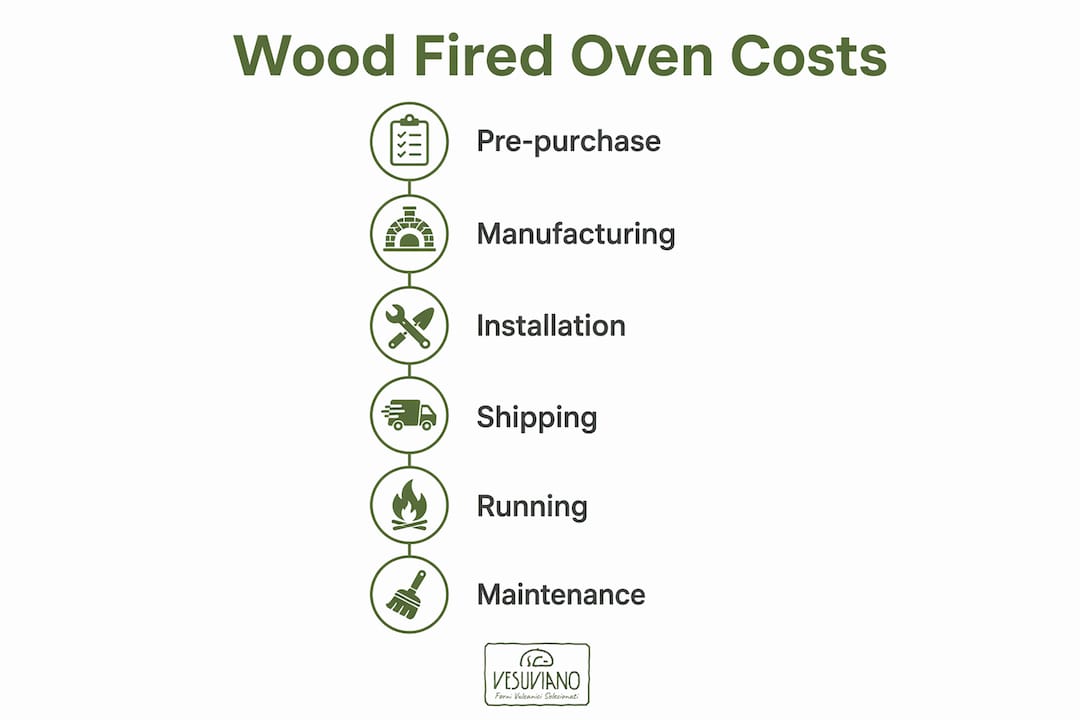
Installation costs are where budgets most often surprise buyers. Ventilation, ducting and fire-protection components can approach or exceed 50% of the total project budget in complex kitchens, particularly where long hood runs or suppression systems are required.
The main line items to cost separately are:
- Extraction hood and ductwork — custom fabrication and routing; cost varies significantly with ceiling height and distance to external wall.
- Flue and chimney — vertical height, fire-rated penetrations and a weatherproof cap; a longer run adds both materials and labour.
- Reinforced base or floor — heavy masonry ovens can require reinforced flooring; structural requirements should be assessed before ordering.
- Enclosure and finishing masonry — tiling, brickwork or steel cladding around the oven body.
- Electrical or gas connection — dedicated circuits or gas supply upgrades if the existing utility provision is insufficient.
- Crane or lift access — where a heavy oven cannot be manoeuvred through standard doorways, crane hire adds cost.
- Permits and building control — local authority notifications or building regulations approval where structural or ventilation works trigger them.
Plan for a contingency of 10–20% of equipment cost for site preparation and technical upgrades. That buffer is not pessimism; it reflects the reality that no two commercial kitchens present identical constraints.
Shipping, import duty and VAT: what UK buyers pay on top
Importing a handcrafted oven from Naples to the UK involves several landed-cost components beyond the supplier invoice. The table below shows the main line items and typical ranges.
| Line item | Typical range | Key variables |
|---|---|---|
| Sea or road freight | — | Distance, freight mode, oven weight |
| Insurance | — | Declared value of shipment |
| UK import duty | Varies by commodity code | Check HMRC tariff schedule |
| UK VAT (20%) | 20% of customs value + duty | Standard rate on commercial goods |
| Delivery to site / crane | — | Site access, distance from port |
Delivery and crane or lift costs vary widely depending on distance and site access; positioning an oven through a standard double door is less costly than crane installation.
Pro Tip: When requesting a freight quote, send the oven’s gross weight, crated dimensions and a photograph of the delivery access point. Suppliers experienced in UK export, such as Vesuviano Forni, can handle customs clearance and coordinate delivery to site, which removes the risk of unexpected demurrage or re-delivery charges.
Running costs: fuel, staffing and routine maintenance
Wood-fired ovens deliver authentic flavour and genuine theatre, but they require skilled labour and complex venting, which raises operating and staffing costs compared with gas or electric alternatives. A trained pizzaiolo who can manage fire, temperature and dough simultaneously is a genuine operational requirement, not an optional extra.
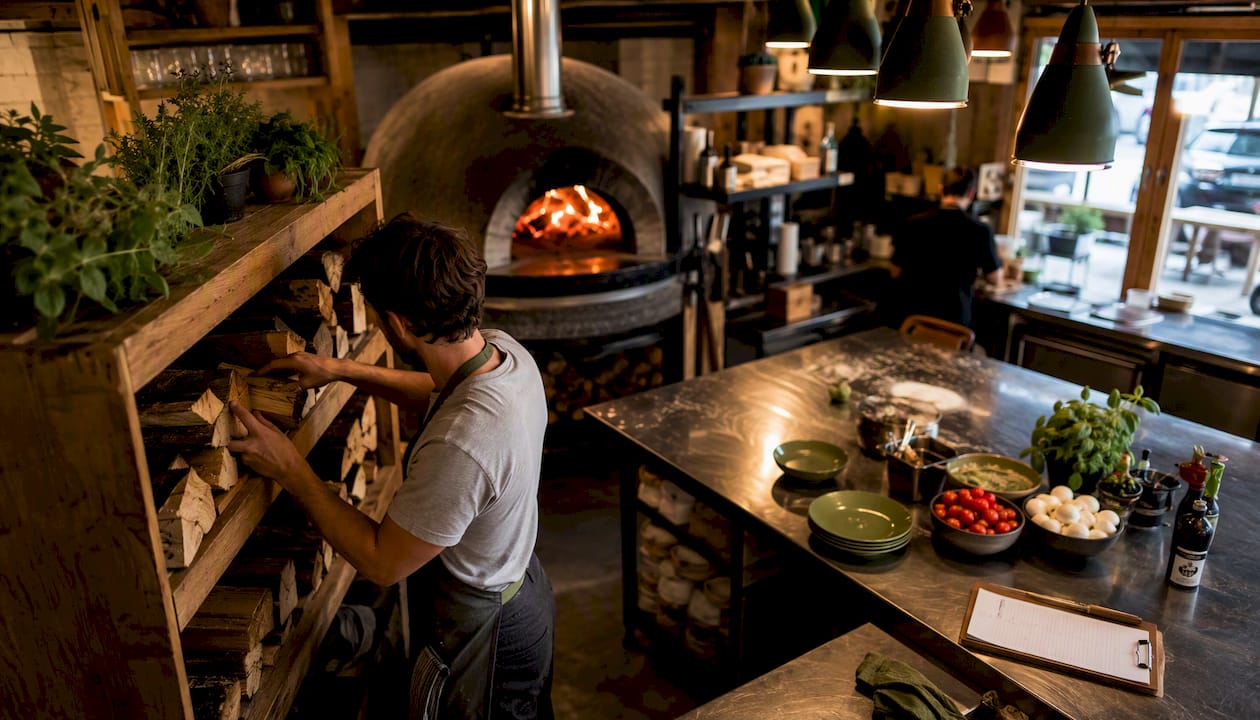
Annual fuel costs depend heavily on service volume. A busy pizzeria firing the oven five or six days per week will consume significantly more hardwood than a restaurant running two or three pizza services. Higher-grade refractory lining and quality insulation improve heat retention and reduce the volume of wood needed to maintain temperature, so the upfront investment in better materials pays back over time.
Routine maintenance includes periodic refractory inspection, flue cleaning (at least annually, often more frequently in high-volume use), and replacement of door seals or gaskets. Budget for a professional service visit once or twice per year.
Pro Tip: Choose an oven with a thick, well-insulated dome and a quality refractory floor. The difference in wood consumption between a well-insulated and a poorly insulated commercial oven is material over a full trading year. Ask your supplier for the dome thickness and insulation specification before ordering.
How to budget and get accurate quotes from suppliers
Accurate quotes require accurate information. Suppliers cannot price site works, ventilation or logistics without specifics, and vague enquiries produce vague estimates.
- Prepare a scaled floor plan of the proposed installation area, including ceiling height and the location of existing utilities.
- Photograph the delivery access route from the street to the installation point, noting any steps, narrow corridors or low ceilings.
- Define your intended throughput: pizzas per service, number of services per week, and peak cover count.
- Specify fuel preference (wood, gas, combined or low-emission wood) and any aesthetic requirements.
- Note any known planning or environmental constraints, particularly if the site is in a smoke-control area.
- Send all of the above with your initial enquiry and request an on-site survey before final pricing.
The typical timeline from first enquiry to a working oven includes the phases of on-site survey, manufacturing lead time (which varies by configuration), shipping and customs clearance, installation and curing, and commissioning. Allow 12–24 weeks end to end for a custom masonry project; modular installs can be faster. Ask every supplier to confirm warranty terms, what commissioning includes, whether the on-site survey carries a charge, and what ventilation scope is included in their installation price. For oven dimensions and capacity planning, detailed guidance is available to help you specify the right size before requesting quotes.
Low-emission technology and UK compliance for wood-fired ovens
Wood-burning appliances in commercial settings face increasing scrutiny from local authorities, particularly in designated smoke-control areas under the Clean Air Act 1993. Before installing a wood-fired oven, confirm with your local authority whether the site falls within a smoke-control zone and whether an exemption or specific appliance approval is required.
Low-emission systems address this directly. The VesuvioBuono® System is designed to eliminate black soot emissions while retaining the cooking character of a traditional wood-fired oven, making it a practical choice for operators in areas where standard wood-burning would face permitting friction. Specifying a low-emission oven from the outset is considerably less costly than retrofitting after a local authority objection.
Pro Tip: Include emissions performance data and duct routing sketches in your initial quote request. Asking suppliers for commissioning emissions test results demonstrates due diligence and gives your planning or environmental health team the documentation they need.
How Vesuviano Forni supports UK buyers end to end
Vesuviano Forni’s three product families cover the main buyer profiles in UK hospitality:
- RealBosco — traditional handcrafted mosaic ovens in wood-fired, gas, electric and rotating versions; the natural choice for operators who want the most authentic Neapolitan aesthetic and cooking character.
- Sebastian — contemporary metal-slat finish ovens in wood-fired, gas and electric versions; suited to modern restaurant interiors where the oven is a design feature as much as a cooking tool.
- VesuvioBuono — wood-fired or combined gas/wood ovens with the low-emission system; the right specification for sites in smoke-control areas or where environmental credentials matter to the brand.
Beyond the ovens themselves, the full-service offer covers on-site survey, technical consultancy, custom design, international logistics, customs clearance, installation, commissioning and after-sales support. That end-to-end capability is what reduces scope creep and the risk of underestimated site works, which is the most common source of budget overruns on UK projects. Every proposal includes a detailed installation plan, warranty terms and commissioning documentation. For buyers considering commercial wood-fired ovens specifically, the product page covers construction details and the full service scope.
Financing options for UK hospitality businesses
Purchasing a commercial oven outright is not the only route. Several financing structures are available for UK hospitality businesses:
Asset finance and hire purchase allow you to spread the capital cost over 12–60 months, with the oven treated as a business asset on your balance sheet from day one. Many specialist equipment finance brokers in the UK work with restaurant and hospitality operators.
Business loans from high-street banks or challenger lenders can fund the full project cost, including installation and site works, which asset finance on the oven alone would not cover.
Leasing keeps the oven off the balance sheet and converts a capital expense into a predictable monthly operating cost, though total cost over the lease term will exceed the purchase price.
Vesuviano Forni does not currently offer in-house financing, but the team can provide the detailed cost breakdown and installation plan that lenders and finance brokers typically require to approve a facility. Speak to your accountant or a specialist hospitality equipment finance broker about the structure that best suits your business.
Key takeaways
A professionally installed commercial wood-fired oven in the UK commonly falls in the £20,000–£38,000 range for a mid-range project, with simple modular installs sometimes under £12,000 and premium custom masonry projects exceeding £50,000. Build method (modular versus on-site masonry) is the primary cost driver.
| Point | Details |
|---|---|
| Total installed cost range | Mid-range projects typically £20,000–£38,000; simple modular installs may be under £12,000; premium custom masonry projects can exceed £50,000. |
| Biggest single cost driver | Build method: prefabricated modular units are more predictable; on-site masonry raises both cost and timeline. |
| Site-preparation contingency | Budget additional contingency of equipment cost for ventilation, structural works and specialist installation. |
| Timeline to commissioning | Allow a considerable period end to end for a custom project; modular installs can be completed faster. |
| Vesuviano Forni | Provides on-site survey, technical consultancy, logistics, installation and warranty across all three product families. |
Why the oven price is never the full story
The figure that surprises most buyers is not the oven itself. It is the gap between the supplier invoice and the total installed cost once ventilation, structural works, shipping and commissioning are added. Having reviewed many UK hospitality projects, the pattern is consistent: buyers who treat the oven price as the project budget routinely face overruns of 30–50% by the time the first pizza comes out of the oven.
The 10–20% site-preparation contingency guidance is a floor, not a ceiling. In a complex kitchen with a long hood run, a reinforced floor requirement and difficult crane access, that figure can be higher. The only reliable way to avoid this is an on-site survey before any contract is signed. A supplier who offers technical consultancy and a detailed installation plan is not adding cost; they are removing uncertainty, which is worth considerably more.
The low-emission question is also underweighted at the enquiry stage. Specifying a VesuvioBuono oven from the start, rather than discovering a smoke-control restriction after the standard wood-fired unit has been ordered, is the kind of decision that saves both money and delay.
Get a precise quote from Vesuviano Forni
Vesuviano Forni handles the full project for UK buyers, from the first site survey through to commissioning and after-sales support. The handcrafted Neapolitan ovens cover every configuration, including the low-emission VesuvioBuono option for smoke-control areas, and the team manages customs clearance, logistics and installation directly.
To receive an accurate quote, send Vesuviano Forni your kitchen floor plan, photographs of the delivery access route, ceiling height, intended throughput and fuel preference. The team will arrange an on-site survey, prepare a detailed installation plan with a full cost breakdown, and confirm warranty and commissioning terms. For on-site custom builds, the same end-to-end service applies. Contact Vesuviano Forni to schedule your survey and begin the process.
Useful sources and further reading
- Commercial wood fired pizza oven cost guide — Current Cost: cost bands, contingency guidance and installation line items for commercial projects.
- Commercial pizza oven cost guide — Selector/Kurlon: mid-range project totals and ventilation cost analysis.
- Commercial pizza oven buyer’s guide — Restaurant Equipment: operational trade-offs between wood, gas and electric for hospitality use.
- VesuvioBuono® System — Vesuviano Forni: full technical details on the low-emission wood-fired system.
- Commercial wood-fired pizza ovens — Vesuviano Forni: product specifications, construction details and service scope.
- Commercial indoor wood-fired pizza oven: UK buyer’s guide — Vesuviano Forni: UK-specific variables affecting price and site requirements.
- Angi outdoor pizza oven cost guide — Angi: labour rates and material considerations for custom outdoor masonry builds.